
Can you patent a mobile app in India? Not merely because you have built a new app, written original source code, or discovered a business opportunity. But a software-enabled invention may qualify for a patent when its claimed contribution solves a genuine technical problem through technical means, meets the usual patentability tests, and is not excluded by Section 3(k) of the Patents Act, 1970.
Think of two founders. One launches an app that helps customers book home cleaning services. Another develops a new method that reliably cuts packet loss during live video calls on unstable networks. Both use software. Yet the first is principally a service model, while the second may contain an invention worth assessing for a patent. Neither can assume that registration is automatic.
This guide explains the difference, how the Indian Patent Office examines computer-related inventions, when copyright or trademarks are more useful, and what to prepare before spending money on a patent application.
Short answer: An app name, a business idea and software code as such are not patentable merely because they are new. A specifically claimed technical invention implemented using software may be patent-eligible. Eligibility is only the first test; novelty, inventive step, industrial applicability and adequate disclosure still matter.
Software patents in India — quick facts
Law
Patents Act, 1970
Section 3(k) excludes specified subject matter
Guidance
CRI Guidelines 2025
Official Patent Office examination guidance
Complete specification
Within 12 months
If you file first with a provisional specification
Examination request
Generally 31 months
Special transitional rules for older applications
Can you patent an app or software in India in 2026?
The Indian law does not grant exclusive rights over an app concept simply because the creator thought of it first. A new interface, a business workflow or a piece of code will not ordinarily satisfy the patentability test just by being useful or commercially successful.
However, the word software does not automatically defeat every patent application. Section 3(k) specifically excludes a computer programme per se—along with mathematical methods, business methods and algorithms. The Indian Patent Office's 2025 Computer Related Inventions (CRI) Guidelines Official ↗ recognise that software-related claims require a careful look at their actual substance and technical contribution.
That means an invention involving code must be explained as more than a list of instructions. The patent application should identify the underlying technical problem, the actual technical solution and the effect achieved by the claimed features. A new physical chip is not invariably required, but ordinary use of a computer or the mere recitation of a processor does not automatically establish eligibility.
Official law: Section 3 of the Patents Act Official ↗.
What exactly does Section 3(k) prohibit?
Section 3(k) excludes four categories. They matter because a developer can accidentally try to patent the wrong part of the product.
| Excluded subject matter | Common software example | What to examine instead |
|---|---|---|
Mathematical method | A formula for scoring users | Whether a separately claimed, genuinely technical implementation exists |
Business method | An automated pricing, cashback or commission rule | Whether an independent technical invention is present beyond the commercial rule |
Computer programme per se | Instructions or code that merely perform ordinary app functions | Whether the claimed system makes a specific technical contribution |
Algorithm as such | Abstract sequence for ranking, matching or sorting | Whether its particular technical implementation solves a technical problem |
Changing a claim's title from "method" to "device" is not enough. The examiner assesses the substance of the invention, not just the wording. A payment app does not become patentable because the claim mentions a server, and a booking system does not become a technical invention merely by adding artificial intelligence.
The CRI Guidelines are examination guidance, not new legislation. The Patents Act, Rules and binding court decisions control wherever there is a conflict.
What counts as a technical effect?
A technical effect is not the same as making a business more profitable or helping users complete a form in fewer clicks. It concerns a demonstrable improvement in the technical operation of a system, device, network or process.
The examples below are illustrative scenarios, not patentability opinions or promises of grant.
| Potentially technical invention to assess | More likely to face Section 3(k) exclusion |
|---|---|
| A specific transmission method that measurably reduces network packet loss | An app that matches customers with electricians |
| A demonstrated sensor-control method that reduces device energy use | A new rule for allocating discount coupons |
| A specific authentication protocol that changes secure key handling | A standard login app with a different colour scheme |
| A defined video-compression process reducing storage or bandwidth | Reordering a recommendation feed by popularity |
| A technically specified image-processing pipeline improving an imaging process | An AI chatbot applying ordinary customer-service scripts |
A practical technical-effect example
Imagine a video-meeting app that struggles on low-bandwidth mobile networks. Its founder invents a specific way to adapt encoding, packet scheduling and error correction to changing network conditions. Tests show fewer dropped frames and shorter delays than a relevant baseline.
The patent question is not simply "Does the app provide better calls?" It is:
- What precise process makes the improvement possible?
- Which claimed steps are different from existing public technology?
- Is the improvement genuinely technical rather than an ordinary configuration change?
- Could another skilled engineer reproduce the method from the specification?
- Would the claimed difference have been obvious to a skilled person?
A credible answer requires a prior-art search, well-drafted claims, implementation details and evidence. A positive benchmark alone does not guarantee that the invention is new or inventive.
The courts discussed in the official CRI Guidelines—including Ferid Allani, Microsoft Technology Licensing and Raytheon—show why the technical contribution must be assessed rather than dismissing an invention solely because software is involved.
Software patent vs copyright vs trademark: what protects what?
App founders often need more than one form of intellectual-property protection. These rights do different jobs, so filing a patent is not a substitute for securing your code or brand.
| Protection | What it can protect | What it does not automatically protect |
|---|---|---|
Patent | A granted, specifically claimed technical invention | Every feature of the app or the whole business idea |
Copyright | Original source code, object code, text, artwork and eligible creative expression | An abstract method or business concept as such |
Trademark | A distinctive app name, logo or brand identifier for relevant goods/services | The underlying functionality of the app |
Trade secrets and contracts | Confidential know-how, private algorithms and commercially sensitive material kept secret | Information that becomes public without confidentiality protection |
Copyright typically arises automatically when eligible original work is created; registration is optional and can be useful as an evidentiary record. IP India's Copyright Office FAQ Official ↗ specifically discusses computer software as a literary work. In practice, ownership also depends on employment, contractor and assignment terms: paying a freelancer to write code does not mean you should ignore the contract governing the rights.
For branding, search for conflicts and choose the appropriate goods/services classes before filing. Downloadable software may be relevant to Class 9, while certain SaaS/software-development services may be relevant to Class 42; the right classification depends on what the business actually offers. See the TaxQue trademark public-search guide and copyright-registration guide.
For a standard food-ordering or booking app, copyright, trademark registration, confidentiality controls and good contracts may offer more immediate value than a patent application. For a company developing a genuinely new compression or cybersecurity process, the patent question deserves closer attention.
Can AI, machine learning or blockchain inventions be patented?
The 2025 CRI Guidelines discuss artificial intelligence, machine learning, blockchain and quantum computing. Using one of these technologies is not, by itself, a patentable invention.
Suppose a business builds an AI model that classifies customer reviews into positive and negative groups. Even an accurate model may primarily perform an abstract information-processing task. Compare that with a specially described algorithm integrated into an industrial sensor system to detect a physical machine fault under defined signal conditions, producing a demonstrated technical improvement.
The second scenario may justify a technical patentability assessment, but only after reviewing prior art, claims, disclosure, excluded subject matter and other statutory conditions.
The guidelines also distinguish AI-assisted inventions, where people use AI as a tool, from claims identifying the AI system itself as an inventor. Inventorship and disclosure need legal review, especially where training data or model architecture is central to the invention.
For AI inventions, preserve the engineering record: system architecture, training-data characteristics, reproducible evaluation procedure, benchmark selection and results. Avoid calling a change a "technical improvement" without showing what specifically improved and why.
Five questions to assess whether your app includes a patentable invention
Before paying filing and drafting fees, prepare short answers to these questions.
A five-point patentability self-check
-
Identify the actual invention
Describe the technical mechanism, not the complete app or product pitch
-
Name the technical problem
Explain a real device, computing, network, security or process limitation
-
Show the technical solution
Describe how the claimed steps or components operate together
-
Search prior art
Compare published patents, papers, product documentation and other disclosures worldwide
-
Test the patent requirements
Review novelty, inventive step, industrial use, sufficiency and Section 3(k)
A simple comparison can help. "Our app makes customer onboarding faster" describes a user or business outcome. "Our specified authentication sequence reduces cryptographic handshakes under defined network conditions" identifies a technical mechanism that can be tested. The second still needs a proper legal and technical review.
How to search for software patents before filing
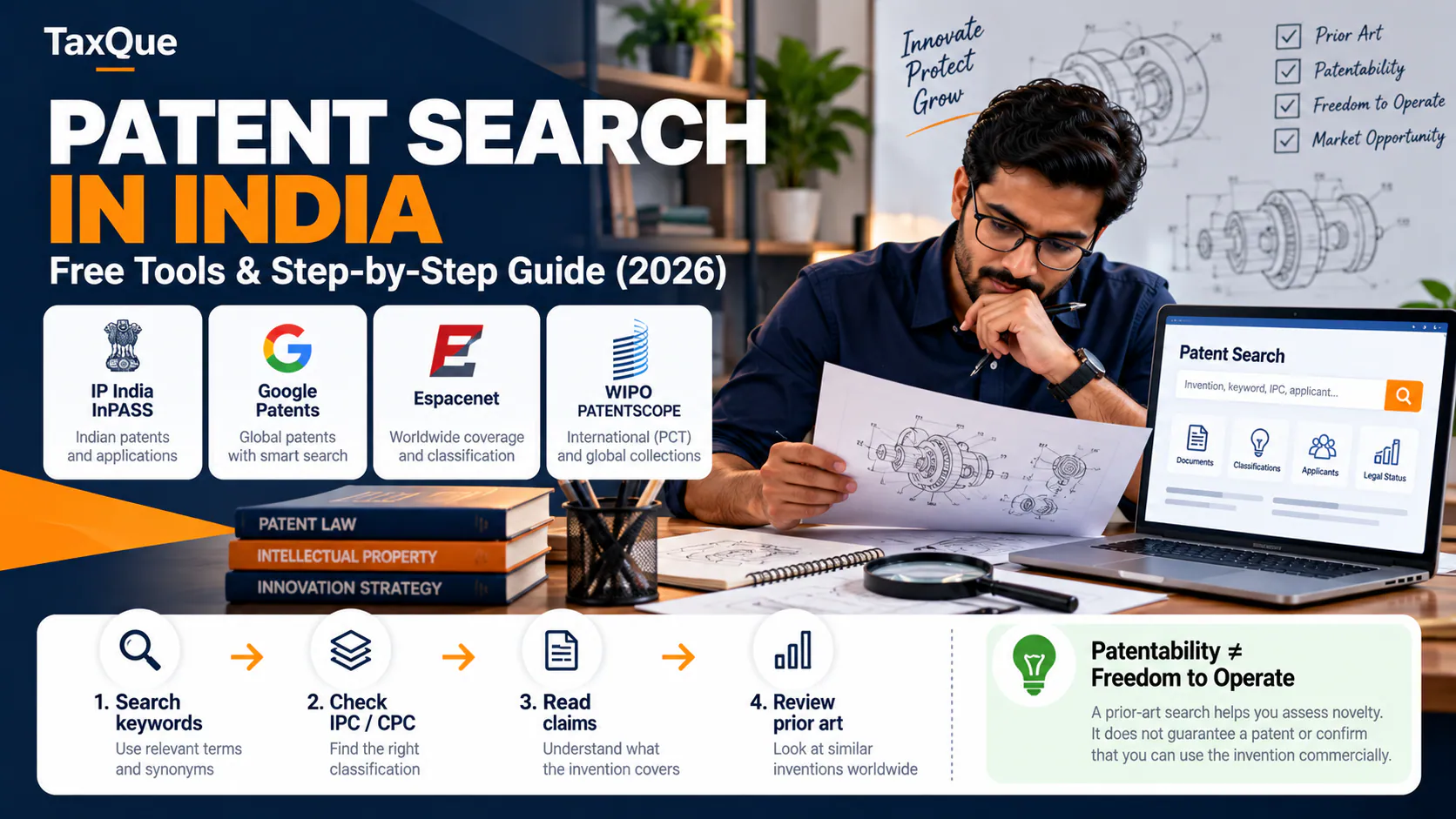
A preliminary prior-art search can identify existing technical solutions and prevent obvious duplication. Search beyond the Indian database because patents and other public technical disclosures from elsewhere can matter.
- Start at IP India's official patent public search Official ↗ for published Indian applications and patents.
- Use Google Patents for broad international keyword searching.
- Search Espacenet and WIPO PATENTSCOPE for patent families, international applications and classification-based searching.
- Test synonyms for the technical function, not merely your app's marketing category. For example, search "packet scheduling", "latency management" and related classifications rather than "video chat app" alone.
- Read the claims and relevant specification sections of the closest documents. A matching headline is not proof that a patent covers the same technical invention.
- Keep a dated search log, including query terms, patent/publication numbers and specific passages relevant to your invention.
A self-search cannot guarantee patentability or freedom to operate. A granted Indian patent held by somebody else can present an infringement risk even if your own improvement is patentable. Read our patent-search guide for a deeper search method.
How to file a software-related patent application in India
Filing a patent is not the same as publishing your app in an app store. The application describes and claims a technical invention, and the Patent Office then examines whether the legal requirements are met.
Step 1: Protect confidentiality before disclosing the invention
Do not assume a launch video, pitch deck or public demo is harmless. Public disclosure of the technical method before filing may destroy novelty, unless a specific statutory exception applies. Use appropriate confidentiality arrangements and seek filing advice before detailed publication.
Step 2: Conduct a technical prior-art and Section 3(k) review
Identify closely related patent publications, non-patent literature and known implementations. Assess whether the alleged innovation is technical, new and non-obvious.
Step 3: Prepare the specification and applicant records
A typical Indian filing uses Form 1 for the application and Form 2 for the provisional or complete specification. Other forms and declarations can apply, including inventorship and foreign-filing statements. A complete specification should sufficiently explain the invention and contain claims defining what is sought to be protected.
If you begin with a provisional specification, Section 9 requires a complete specification within 12 months of filing; missing that deadline can result in the application being deemed abandoned. A provisional filing is not a granted patent.
Step 4: File using the Patent Office's e-filing system
Use IP India's patent e-filing portal Official ↗. Check the applicant category, supporting documents, signing requirements and official fee before submitting.
Step 5: Request examination on time
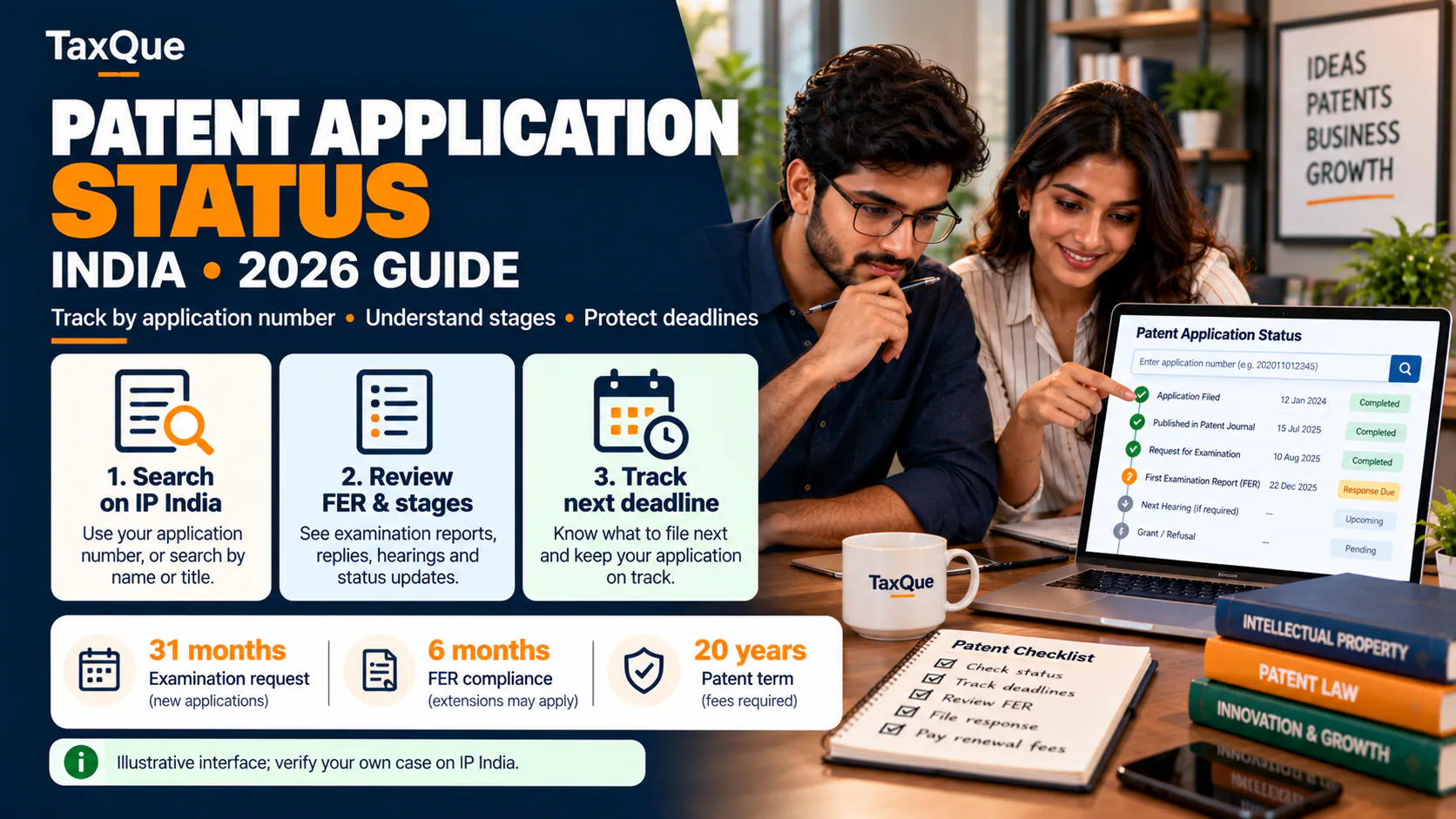
Filing alone does not mean the application will be examined automatically. Under Rule 24B, the general period for making an examination request (Form 18) is 31 months from the applicable earliest filing or priority date. Important transitional provisions preserve the former time limit for certain applications filed before the 2024 amendment.
Expedited examination (Form 18A) is available only where a prescribed eligibility ground applies; qualifying startup status is one possibility, not a promise of immediate grant. See Rule 24C Official ↗.
Step 6: Respond to examination objections
The First Examination Report may question novelty, inventive step, clarity, support in the specification or Section 3(k) eligibility. Reply with a technically grounded explanation and amendments where permitted; hearings or further communications may follow. The Patent Office decides whether to grant or refuse.
Step 7: Maintain the patent after grant
A granted patent has its own maintenance and disclosure responsibilities. Budget for official renewals and other applicable requirements rather than viewing the filing fee as the entire lifetime cost.
Official software patent fees in India: 2026 planning guide
The amounts below are indicative e-filing fees from the Patent Office's published First Schedule for the relevant applicant categories. Check the live portal before paying, because total fees vary by entity classification, application length, claims, filing route and amendments.
| Filing or request | Individual / eligible startup / small entity / educational institution | Other applicants |
|---|---|---|
Patent application, Form 1 (base fee) | ₹1,600 | ₹8,000 |
Ordinary examination request, Form 18 | ₹4,000 | ₹20,000 |
Eligible expedited examination request, Form 18A | ₹8,000 | ₹60,000 |
These figures do not include patent-agent drafting or advisory fees, excess-claim or extra-page charges, potential foreign-filing costs, or grant-related renewals. Form 18A fees are relevant only where expedited examination is legally available.
Source: IP India — First Schedule of Patent Fees Official ↗ and official forms Official ↗.
Common mistakes when trying to patent an app
- Patenting the business model instead of the technical method. A smart pricing model remains a business concept even if software automates it.
- Claiming the entire app. A patent protects only the invention defined in its granted claims, not every feature visible to users.
- Writing claims with only desired results. "Secure and fast" without the actual implementation gives the examiner little to evaluate.
- Treating copyright and patents as interchangeable. Copyright can protect original code; it does not automatically grant a monopoly over its function.
- Disclosing too soon. A public description may become prior art against your own application.
- Assuming AI makes an invention eligible. The technical contribution, not the AI label, matters.
- Ignoring ownership records. Co-founders, employees, consultants and contractors should document invention ownership and assignments.
- Confusing a filed application with a granted right. Filing creates an application and a filing date, not an assured patent.
- Skipping freedom-to-operate analysis. A new improvement could still implicate an earlier patent.
A practical startup example: should you patent, copyright or trademark?
Consider a fictional startup called QueueFlow that develops an appointment-booking app. Its business includes the booking workflow, brand identity, original front-end code and a new network synchronisation method used when devices repeatedly go offline.
- The brand name and logo may be candidates for trademark protection after a clearance search.
- The original code and graphics can receive copyright protection, subject to ownership and originality.
- The appointment-booking business model is unlikely to become patentable merely because it runs in an app.
- The network synchronisation method, if genuinely different, technically effective and adequately disclosed, may justify a patentability assessment.
This approach protects different parts of the same business without treating all intellectual property as a single application.
What to prepare before speaking to a patent professional
- ○ One-page description of the technical problem
- ○ Diagram of the app's relevant architecture, data flow or device interaction
- ○ Explanation of what is new compared with existing solutions
- ○ Technical benchmarks or prototype results, where available
- ○ Names of the inventors and ownership/assignment documents
- ○ Details and dates of any public demos, posts, launches or disclosures
- ○ Closest patent publications and research papers found in your search
- ○ Budget for filing, examination, drafting and maintenance
Final takeaway: protect the invention, not just the app idea
India does not grant patents merely for app concepts, standard software code or automated business methods. But it is equally mistaken to say that anything using software is barred. A specifically claimed technical invention can be examined under the Patents Act and the 2025 CRI Guidelines, with Section 3(k) forming only one part of the assessment.
For many founders, the immediate priorities are source-code ownership, copyright protection, brand clearance and trademark registration. Where a distinctive technical mechanism exists, begin with a professional prior-art search and carefully evaluate patent filing before disclosure.
TaxQue provides information and assistance with business and intellectual-property compliance. If you're weighing patent filing against copyright or trademark protection, explore our patent registration service or contact TaxQue to discuss the appropriate next step. Eligibility and any filing outcome depend on the facts and Patent Office examination.
Official references and useful links
- Patents Act, 1970 — Section 3(k) Official ↗
- IP India — Guidelines for Examination of Computer Related Inventions (2025) Official ↗
- Patents Act — Section 9 (provisional and complete specification) Official ↗
- Patents Rules — Rule 24B (examination) Official ↗
- Patents Rules — Rule 24C (expedited examination) Official ↗
- Official patent-fee schedule Official ↗
- IP India — Patent filing forms and fees Official ↗
- IP India — Public patent search Official ↗
- IP India — FAQs on copyright and computer software Official ↗
Information reviewed on 18 October 2026. Legal rules and fees must be checked against the current Patent Office records when filing; this educational guide is not a patentability opinion.