
Thinking about filing your freelance income as salary because the money comes into your bank account every month? That is an easy mistake to make. A client invoice is usually not a salary slip, and the ITR form, deductible expenses, advance-tax rules and disclosure of overseas earnings can be different.
For FY 2025–26 (Assessment Year 2026–27), most freelancers who earn business or professional income will need ITR-3 or ITR-4, depending on what they do, whether they qualify for presumptive taxation, their total income and whether they have foreign income or assets. ITR-4 is not available to every freelancer, and getting paid by an overseas client does not make that income tax-free in India.
This guide shows you how to choose a form, compare actual expenses with Section 44ADA, reconcile Indian TDS and foreign payments, and file without treating GST turnover as income-tax profit. The deadlines below were checked against Income Tax Department guidance available on 16 October 2026.
ITR filing for freelancers: the quick answer
| Your situation | Usually relevant form | What to check first |
|---|---|---|
Resident freelancer eligible for Section 44ADA, total income within ₹50 lakh and no ITR-4 disqualification | ITR-4 (Sugam) | Specified profession, gross receipts, residence and other income |
Freelancer reporting actual professional expenses or not eligible for ITR-4 | ITR-3 | Books, profit calculation and audit applicability |
Freelancer claiming 44ADA but holding overseas assets or having reportable foreign-source income | ITR-3 | Foreign schedules and disclosure obligations |
Freelance income plus salary, interest or capital gains | Usually ITR-3 or eligible ITR-4 | Type of capital gain and other ITR-4 exclusions |
Person earning salary only, without business/professional income | Not necessarily ITR-3/4 | Choose based on salary and other income |
₹75 lakh under Section 44ADA is a gross-receipts ceiling in qualifying cases; ₹50 lakh for ITR-4 is a separate total-income ceiling. You may be eligible to calculate profits under Section 44ADA but still need ITR-3 rather than ITR-4.
Official references: Income Tax Department — applicable ITR forms Official ↗ and ITR-4 FAQs Official ↗.
Who is treated as a freelancer for income-tax purposes?
A freelancer generally earns money under contracts for independent services: software development, design, editing, consulting, marketing, accounting or similar work. The label printed on an invoice is not conclusive. The real relationship matters.
For example, Nisha receives ₹90,000 every month from a company for independent website-development work. She invoices the company, bears her own costs and does not receive employee benefits. Her receipts are ordinarily examined as business or professional income, not automatically salary just because payment arrives monthly.
If Nisha is genuinely an employee, salary reporting rules may apply instead. Check the contract, actual working arrangement, tax deducted and Form 16 versus Form 16A before choosing your return.
Is every freelance occupation eligible for Section 44ADA?
No. Section 44ADA covers specified professions under the Income-tax Act, including legal, medical, engineering/architecture, accountancy, technical consultancy, interior decoration and notified professions such as information technology. A general label such as creator, content writer, influencer, graphic designer or consultant is not enough on its own to establish eligibility.
Where the activity is not a specified profession, the appropriate treatment might involve actual accounts or a different presumptive provision such as Section 44AD if that activity and taxpayer meet its conditions. The nature of the services, contract and receipts should be reviewed.
Source: Income Tax Department — Section 44ADA and specified professions Official ↗.
ITR-3 versus ITR-4: how to choose correctly
When ITR-4 may work
ITR-4 is a simplified option for qualifying resident individuals, eligible HUFs and resident firms other than LLPs who use the relevant presumptive income provisions. For a typical individual freelancer using Section 44ADA, key checks include:
- You are a resident and ordinarily resident individual for ITR-4 purposes.
- Your activity comes within the profession specified for Section 44ADA.
- Your professional receipts are within the applicable ₹50 lakh or ₹75 lakh ceiling.
- Your total income does not exceed ₹50 lakh and you do not have disqualifying income or assets.
- You are not required to disclose foreign assets, foreign financial interests or signing authority in overseas accounts, and do not otherwise fall into the excluded categories.
ITR-4 eligibility has other restrictions, including certain company directorships, unlisted shares, income or assets outside India, brought-forward losses and various capital gains. Read the current year's instructions rather than assuming last year's form still fits.
When ITR-3 is safer or necessary
ITR-3 is designed for individuals and HUFs with income from business or profession where ITR-4 is unavailable or inappropriate. You would ordinarily consider ITR-3 if you report actual profit and loss, are not eligible for presumptive taxation, have foreign assets or reportable foreign-source income, or need the fuller schedules available in ITR-3.
Foreign customer ≠ automatically foreign asset. Receiving a fee from a client outside India and holding a balance in a foreign bank or financial account are different facts. Foreign-source income and overseas reporting require a case-specific review, but a qualifying freelancer can still compute professional profits under Section 44ADA in ITR-3 where permitted.
Section 44ADA explained with examples
For qualifying professions, Section 44ADA allows 50% of gross professional receipts, or a higher amount voluntarily declared, to be treated as professional profit under the presumptive scheme.
The ordinary receipts ceiling is ₹50 lakh. It increases to ₹75 lakh if cash receipts meet the statutory 5% condition. Qualifying non-account-payee instruments can be treated as cash for this purpose, so check the payment mix carefully.
Example 1: ₹18 lakh of professional receipts
Assume a resident individual software professional qualifies for Section 44ADA and has only normal slab-rate income:
| Particulars | Illustrative amount |
|---|---|
| Gross receipts from clients | ₹18,00,000 |
| Deemed professional expenses at 50% | ₹9,00,000 |
| Presumptive professional profit | ₹9,00,000 |
| Other taxable income | Nil |
| Total income before applicable rounding | ₹9,00,000 |
For AY 2026–27, a resident individual with qualifying normal-rate taxable income up to ₹12 lakh may be entitled to the Section 87A rebate under the default new tax regime, subject to the legal conditions. In this simplified example, the final income tax may be nil; any TDS refund still depends on the complete return and verification.
The rebate is not an exemption from filing and does not automatically apply to every tax category, taxpayer or special-rate income.
Source: Income Tax Department — tax rates and 87A rebate for AY 2026–27 Official ↗.
Example 2: actual expenses exceed half the receipts
Suppose receipts are ₹20 lakh but allowable business expenses are ₹13 lakh. Actual profit is ₹7 lakh; the 44ADA presumptive figure at 50% would be ₹10 lakh.
Claiming the ₹7 lakh profit is not simply a matter of selecting a lower figure in ITR-4. Accounting records and Section 44ADA(4) conditions, including potential tax-audit requirements where the statutory test is met, need examination. Compare the overall tax and compliance impact before selecting the method.
What expenses are already covered under 44ADA?
Laptop purchases, software subscriptions, home-office costs, broadband, freelance platform commissions and similar ordinary business costs are reflected in the statutory presumptive calculation. Do not subtract them again from the 50% deemed profit in a 44ADA computation.
If using actual accounts in ITR-3, deductions depend on business purpose, evidence, applicable depreciation and other tax rules. A personal expense does not become deductible merely because the freelancer also uses a laptop.
Freelancer ITR filing deadlines for AY 2026–27
| Filing situation | Relevant date | Status on 16 October 2026 |
|---|---|---|
Non-audit ITR-3 or ITR-4 covered by the revised normal business/professional due date | 31 August 2026 | Already passed |
Specified tax-audit cases covered by CBDT Circular 07/2026: audit report | 21 October 2026 | Upcoming |
Same specified audit cases: income-tax return | 21 November 2026 | Upcoming |
AY 2026–27 belated return under Section 139(4) | 31 December 2026 | Upcoming |
Revised return under Section 139(5), subject to conditions and completion of assessment | 31 March 2027 | Upcoming |
The September 2026 CBDT extension does not apply to every freelancer. Circular No. 07/2026 specifically extended the specified audit-case ITR deadline from 31 October to 21 November 2026 and the audit-report deadline from 30 September to 21 October 2026. Non-audit taxpayers should not treat 21 November as a blanket extension.
Source: Income Tax Department announcements Official ↗ and CBDT announcement on the AY 2026–27 audit extension Official ↗.
Missed 31 August: what happens now?
You may be able to file a belated return by 31 December 2026 if the return is otherwise permitted and the assessment has not been completed. A late-filing fee under Section 234F can be ₹1,000 where total income does not exceed ₹5 lakh or ₹5,000 otherwise, subject to the provision's conditions. Interest may also apply to unpaid tax.
A belated return does not necessarily preserve all rights to carry forward losses or other benefits of timely filing. If you already filed and made a genuine mistake, examine the revised-return route instead. Read our revised ITR guide.
Also e-verify your submitted return within the prescribed 30-day period; uploading a return without completing verification is not the same as finishing filing.
Sources: Department FAQ on belated/revised returns Official ↗ and ITR-4 e-filing guide Official ↗.
TDS deducted by Indian clients: reconcile before filing
Indian businesses may deduct tax on freelancer payments under Section 194J, 194C, or another relevant provision, depending on the service and circumstances. Under Section 194J the usual rate is 10% for professional fees and 2% for qualifying fees for technical services; rates, thresholds and payer obligations depend on the transaction. It is incorrect to assume every freelance invoice attracts the same TDS.
Here is an illustrative reconciliation:
| Detail | Amount |
|---|---|
| Professional invoice (excluding GST) | ₹1,00,000 |
| Illustrative 10% TDS | ₹10,000 |
| Amount received before other adjustments | ₹90,000 |
| Gross receipt to review for income tax | ₹1,00,000, not automatically ₹90,000 |
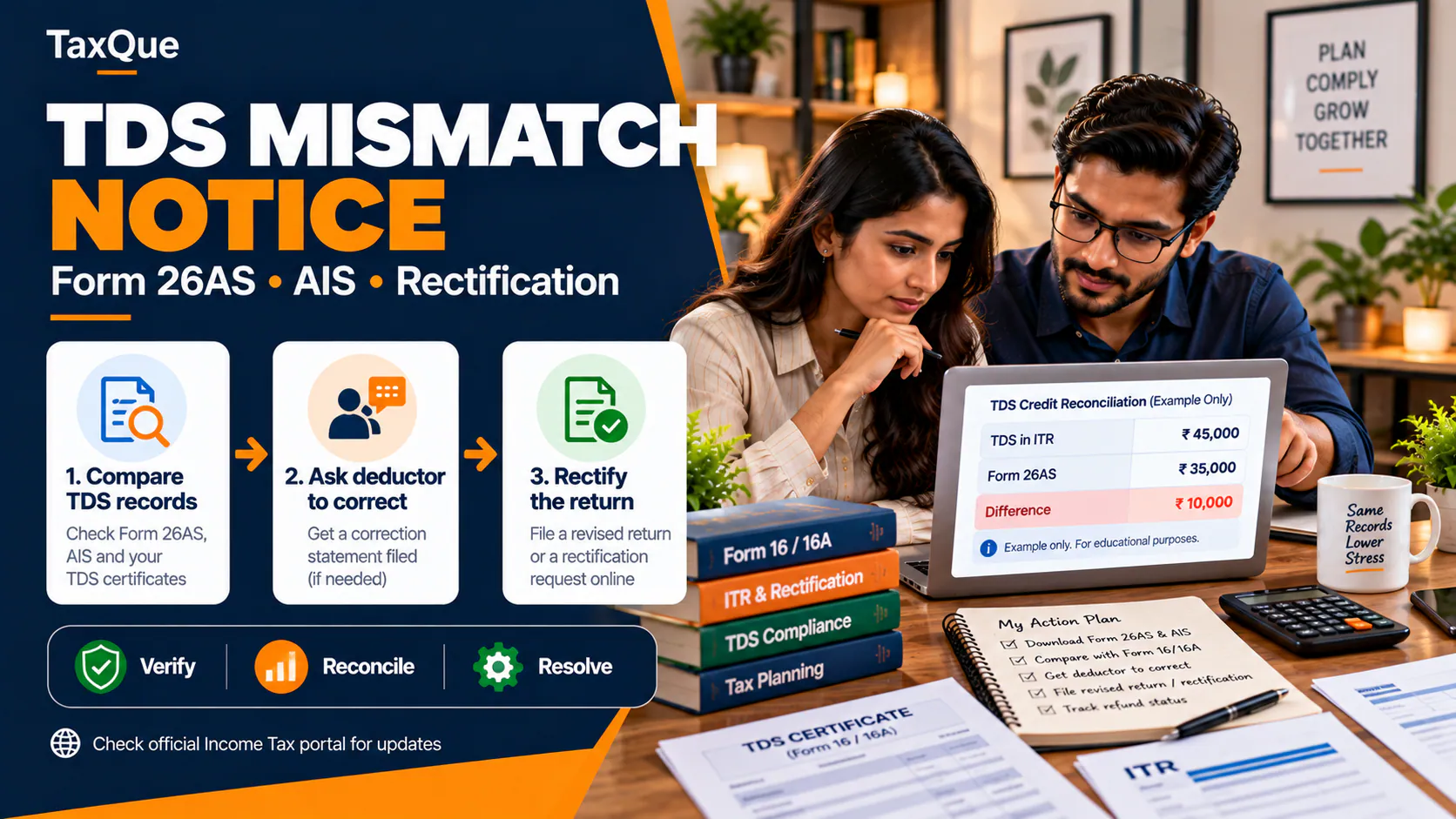
The ₹10,000 is tax already deducted on your behalf, not an expense or reduction to your professional fee. Match the client's TDS certificate against Form 26AS, AIS and your invoices. If it is missing, contact the deductor for correction rather than claiming an unsupported credit.
Source: Income Tax Department TDS rate table Official ↗. See also TDS mismatch notices.
Foreign clients, overseas platforms and foreign tax credit
A freelancer in India may receive payment in USD, EUR, GBP or another currency from a direct overseas client, marketplace or software platform.
1. Declare the income according to tax residence and source rules
A resident and ordinarily resident individual is generally liable to Indian tax on worldwide income, subject to applicable provisions. Non-residents and residents but not ordinarily resident individuals can have different scopes of taxable income.
Do not equate “no TDS deducted by the foreign customer” with “no Indian tax due.” Maintain the contract, invoices, platform statements, settlement report and bank credit trail.
2. Reconcile gross fees, commissions and currency conversions
Example: an overseas platform records a customer fee equivalent to ₹2,00,000, deducts a ₹20,000 platform commission and remits ₹1,80,000. The correct books must reflect the gross contractual receipt and relevant fee separately where that is the underlying arrangement; ₹1,80,000 is not automatically the total amount billed.
Foreign-currency translation has prescribed tax rules and relevant conversion dates. Do not apply one arbitrary exchange rate to every invoice or assume that the bank credit date always determines the taxable rupee amount.
3. Understand foreign assets and bank accounts
Foreign payment platforms, wallets, overseas accounts, foreign shares and signing authority can create distinct questions. The ITR-4 instructions exclude taxpayers with relevant foreign assets, signing authority or foreign-source income. Some overseas items require specific foreign-asset schedules and may make ITR-3 necessary.
4. Claim foreign tax credit only where supported
Where tax was genuinely withheld abroad and Indian law/treaty rules permit credit, examine foreign tax credit under Rule 128 and Form 67, with supporting evidence. The Income Tax Department's current Form 67 guidance says it should be filed on or before the Section 139(1) due date. Do not claim a credit merely because a platform charged an ordinary service commission.
Source: Income Tax Department — Form 67 user manual Official ↗.
GST for freelancers: separate from income tax
Income tax is computed under income-tax law. GST is a separate tax on taxable supplies and can apply even where income-tax profit is modest.
For suppliers of services, the general registration threshold is usually ₹20 lakh of aggregate turnover (₹10 lakh in certain specified states), subject to applicable mandatory-registration rules, exemptions and the place/nature of supply. Export turnover is generally included when testing aggregate turnover.
Not every payment from abroad is automatically a zero-rated export of services. The IGST Act's export conditions must be satisfied, including the recipient's location, place of supply, distinct-person rules and permitted receipt of consideration.
Registered eligible exporters may supply services under a Letter of Undertaking (LUT) without payment of integrated tax, subject to prescribed conditions, or use another lawful zero-rated route. See our GST LUT guide and GST return filing service.
For GST registration rules and forms, verify details at the GST portal Official ↗ and the CBIC GST website Official ↗.
Advance tax and tax regime selection
Freelancers whose estimated tax liability after applicable credits is ₹10,000 or more ordinarily need to check advance-tax liability.
For a taxpayer using Section 44ADA, the full advance-tax liability for the presumptive income can generally be discharged by 15 March of the financial year. Actual-account cases ordinarily follow the applicable instalment schedule.
The new tax regime is the default for eligible individuals in AY 2026–27. If you have income from business or profession and want to opt for the old regime, Form 10-IEA generally must be filed by the original Section 139(1) due date, with restrictions on subsequent switching. Do not assume an old-regime selection is an informal checkbox that can always be changed in a late return.
Source: Income Tax Department — Form 10-IEA manual Official ↗. Read our advance tax payment guide.
Documents to collect before filing
- Annual summary of all client invoices, credit notes and receipts, including overseas payments
- Business and personal bank statements used for the financial year
- Form 26AS, AIS and TIS, plus Form 16A from Indian clients
- Payment-platform statements and platform commission reports
- Records of foreign-currency receipts and relevant conversion calculations
- Actual business expense bills and asset purchase records if filing on regular accounts
- Overseas withholding documents and Form 67 materials where foreign tax credit is claimed
- GST returns and turnover reconciliation if GST-registered
- Advance tax and self-assessment tax challans
- Old-regime deduction evidence and any applicable Form 10-IEA acknowledgement
- Previous ITR and any brought-forward loss or depreciation schedules
If you use 44ADA, maintaining complete records is still useful for commercial, GST and reconciliation purposes even where detailed books are not mandated by the presumptive provision.
How to file freelancer ITR on the income-tax portal
Freelancer ITR filing workflow
-
Identify income and residence
Separate salary, professional receipts, foreign earnings and other income; establish residential status.
-
Choose ITR and tax method
Check ITR-3 versus ITR-4 eligibility, 44ADA versus actual profit and possible audit.
-
Reconcile evidence
Match invoices, bank deposits, AIS, 26AS, GST turnover, TDS and foreign income.
-
Compute and pay tax
Compare regimes, consider Form 10-IEA where timely applicable, and settle interest or self-assessment tax.
-
Complete return schedules
Log in at the official portal, select AY 2026–27 and the correct form, then review every schedule and disclosure.
-
Validate and e-verify
Submit, retain acknowledgement and complete verification within the prescribed timeframe.
You can start at the Income Tax e-Filing portal Official ↗. The exact on-screen steps differ depending on whether you use ITR-3 or ITR-4 and which online/offline utility is available.
Errors freelancers should catch before pressing Submit
- Reporting only the bank amount: TDS or platform commission was deducted before payment, causing gross receipts to be understated.
- Using 44ADA without checking the profession: A job title alone does not establish that the activity is a specified profession.
- Confusing 44ADA receipts and ITR-4 total-income thresholds: These are separate tests.
- Omitting foreign earnings or financial interests: An overseas client or platform account needs its own income and disclosure review.
- Treating GST as income-tax profit: GST turnover, taxable receipts and net business profit are different measurements.
- Claiming the same expenses twice: Ordinary costs are already reflected in 44ADA's deemed-expense calculation.
- Assuming a deadline extension applies to everyone: The 21 November 2026 extension concerns specified audit cases.
- Failing to reconcile TDS: Claim only legitimate credits supported by the reporting records.
- Ignoring Form 10-IEA or Form 67 deadlines: Both can matter when selecting the old regime or claiming foreign tax credit.
- Not e-verifying: Submission alone does not finish your filing.
When professional review is worth considering
A relatively straightforward resident professional with only Indian clients and clean TDS records may be able to file independently. If you have mixed freelance and employment income, cross-border contracts, foreign assets, complex platform deductions, carried-forward losses, a tax audit or a disputed 44ADA classification, individual review is more important.
TaxQue can help you assess the return form, reconcile receipts and TDS, review the available tax method and prepare the filing. Explore ITR-4 filing support, or review the full ITR document checklist.
Explore TaxQue's ITR filing services
The bottom line
Freelancer tax filing is not simply entering an annual income figure. Start with what work you actually perform, identify whether the income belongs to a specified profession, then confirm your residence, foreign exposures and available ITR schedules. Only after those checks should you choose presumptive taxation or actual accounts.
For AY 2026–27, the ordinary 31 August non-audit due date has passed as of 16 October 2026. If you have not filed, check the belated-return route; if your case requires an audit, verify whether the 21 November deadline extension applies. Above all, reconcile your invoices and tax credits before sending the return.
Official sources and editorial verification
- Income Tax Department: ITR applicability for AY 2026–27 Official ↗
- Income Tax Department: ITR-4 eligibility and Section 44ADA FAQs Official ↗
- Income Tax Department: ITR-4 AY 2026–27 due-date FAQ Official ↗
- CBDT: AY 2026–27 audit-case extension notice Official ↗
- Income Tax Department: AY 2026–27 belated and revised return FAQ Official ↗
- Income Tax Department: Form 10-IEA Official ↗
- Income Tax Department: Form 67 foreign tax credit Official ↗
- Income Tax Department: TDS rates Official ↗
- GST portal Official ↗ and CBIC GST Official ↗
Updated 16 October 2026. Educational information; deadlines, return utilities and filing requirements should be rechecked against official notices for the exact taxpayer before submission.