Your consultancy invoices are tidy. Then the tax checklist asks about business profits, investment sales, prior losses and a regime option. The problem is not that your business is unusual—it is that one form has to tell the whole story.
This guide now covers ITR-3 preparation for Tax Year 2026–27 under the Income-tax Act, 2025. The existing AY 2025–26 slug stays unchanged, with a clearly separated historical section for readers checking an older return.
Old law vs new law: Income from 1 April 2026 to 31 March 2027 belongs to Tax Year 2026–27. Section 263 and Rule 164 govern the new-law return framework. FY 2025–26 / AY 2026–27 and earlier use the saved 1961 Act and the forms applicable to those periods.
ITR-3 has not simply become Form 130
The new Rules retain ITR-3. Rule 164(7) identifies it for individuals or HUFs with business/professional income who are not covered by the specified simpler return categories.
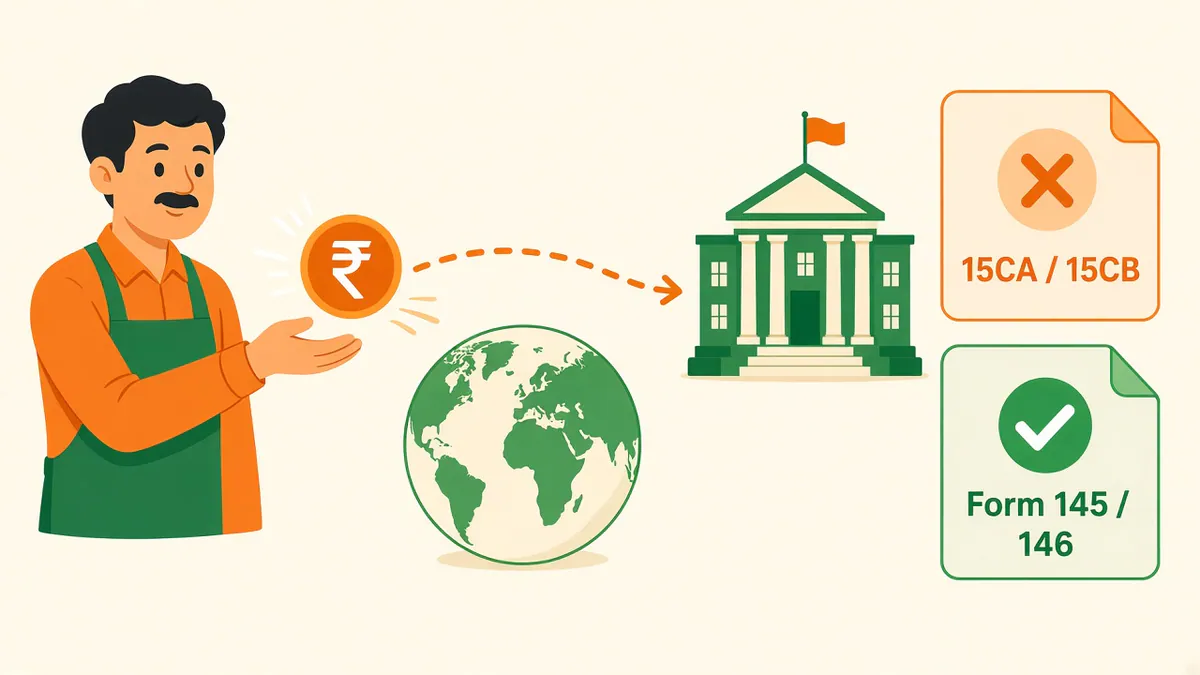
Forms 130 and 131 are TDS certificates, not replacements for the business income-tax return. Form 130 concerns salary and specified senior-citizen cases; Form 131 covers relevant non-salary deductions. Keeping that distinction clear prevents choosing a certificate where an annual return is required.
A consultant with salary plus professional income must consider both. A sole proprietor should consider the full business facts. ITR-4 is a conditional simplified route, not an automatic entitlement for anyone calling themselves a small freelancer.
Rule 164 ties its presumptive-income condition to Section 58. Check every eligibility condition before choosing it; do not transplant an old-law threshold summary or assume every established field is a new requirement.
The current legal map worth keeping beside you
| Subject | Current new-law reference |
|---|---|
| Income heads | Section 13 |
| Return obligation | Section 263 |
| ITR-3 eligibility | Rule 164(7) |
| Presumptive computation, where eligible | Section 58 |
| Tax audit | Section 63 |
| Default-regime calculation | Section 202 |
| Resident-individual rebate | Section 156 |
| Relevant non-salary TDS certificate | Form 131 |
| Annual information statement | Section 510, Rule 245, Form 168 |
ITR-3 does not automatically mean a tax audit. Apply Section 63 to the actual facts. If audit is required under the new-law framework, the prescribed report is Form 26; it is not the annual business return itself.
Build the return from records, not bank credits alone
Start with invoices, contracts, receipts, expenses, capital balances, liabilities and depreciation workings. Reconcile them with tax certificates and the annual information statement.
A loan, capital introduced by the owner, an internal transfer and a customer receipt do not all have the same income-tax treatment. Nor does every business bank debit become an allowable expense.
Keep investment transactions separate from operating revenue. The relevant asset type, acquisition date, transfer date and applicable statutory conditions determine gain treatment. Do not apply a single property or securities rate to every sale.
Under the new law, Form 168 is the prescribed annual information statement. Treat reported information as evidence to reconcile, not permission to omit genuine income or force an incorrect duplicate entry into your return.
Worked example: receipts before and after TDS
Meera’s books show ₹12,00,000 consultancy receipts before TDS. Clients deduct ₹1,20,000, and the bank receives ₹10,80,000. Assume no GST or timing differences in this illustration and ₹2,00,000 fully allowable expenses.
Her starting business profit is ₹12,00,000 − ₹2,00,000 = ₹10,00,000, not ₹10,80,000 minus expenses. The ₹1,20,000 is separately reconciled as potential TDS credit through the relevant Form 131 and departmental records.
The example explains the gross-income/credit distinction. It does not decide audit liability, final tax, special deductions or whether Meera meets the resident-individual rebate conditions. It also does not give a salary standard deduction against consultancy profit.
Regime selection: do not mechanically request Form 10-IEA
For current Tax Year 2026–27, use Section 202(4) read with Rule 136. Rule 136 places the relevant option or withdrawal in the return furnished under Section 263(1).
That is different from telling every business taxpayer to file the old Form 10-IEA. Follow the new-law return’s eligibility questions and timing requirements, including the effect of prior choices where relevant. A lower calculator result does not itself establish a valid election.
The default Section 202 bands begin at ₹4 lakh nil, followed by 5%, 10%, 15%, 20%, 25% and 30% bands up to/above ₹24 lakh. A qualifying resident individual may receive Section 156 rebate up to ₹60,000 where total income does not exceed ₹12 lakh, with statutory limitations. An HUF cannot claim that individual rebate.
TaxQue tip: Maintain three folders: current Tax Year records, prior-year decisions and tax-credit evidence. Mixing current Form 131 records with old-year certificates can create a mismatch that looks like missing income.
Filing readiness is not a launch announcement
Tax Year 2026–27 ends on 31 March 2027. Prepare the accounts and pay applicable taxes during the year; do not assume a completed annual return can be submitted for an unfinished period.
Check the Department’s operational announcement for the applicable ITR-3 utility and filing mode. Rule 164 establishes the form framework; operational availability needs its own confirmation.
Retain the final return, acknowledgement, payment records and verification confirmation when filing becomes applicable. Use the actual utility’s instructions rather than screenshots from another year.
Historical section: the AY 2025–26 return
AY 2025–26 covered FY 2024–25 under the 1961 Act. Its ITR-3 capital-gains schedules distinguished relevant transfers before versus on/after 23 July 2024. Its Form 10-IEA history and prior valid elections needed assessment under that old framework.
Do not rewrite those old schedules using current Section 202 or Form 168. Ordinary belated/revised windows for that year have closed. A conditional old-law updated return may remain possible; the new-law updated-return designation ITR-UN under Rule 165 is a separate framework, not an automatic replacement for old-year ITR-U.
Close the records before final review
Ask for a reconciliation of opening balances, current receipts and expenses, tax credits and closing balances. Explain differences between invoices and bank receipts with identifiable entries. The reviewer should be able to follow the figures without guessing whether an unexplained bank credit was a sale, loan or owner transfer.
Reader questions
Was ITR-3 replaced by a numbered certificate?
No. Rule 164 retains ITR-3. Forms 130 and 131 serve different TDS-certificate purposes.
Does every ITR-3 taxpayer need audit?
No. Audit is a separate Section 63 test. Check the facts and applicable report requirement.
Is Form 10-IEA automatically required for the current Tax Year?
Do not assume so. Section 202(4) and Rule 136 govern the current return-based option framework.
Can I use current forms to revise AY 2025–26?
No. Use that older year’s saved-law remedy and applicable forms, if eligible.
References
- Notified Rules, 2026: Rules 136, 164, 165 and 245; Forms 26, 131 and 168 Official ↗.
- Income-tax Act, 2025 as amended by Finance Act, 2026 Official ↗.
- Department Form 131 FAQ Official ↗.
- CBDT transition guidance Official ↗.
Need your business records checked? TaxQue can help identify the right year, return and reconciliation. Contact: info@taxque.in | 9311256088 | taxque.in.