TDS is tax deducted from a covered payment; TCS is tax collected on a covered receipt or transaction. The payer or collector sends it to the government and reports the required details so the appropriate person's credit can be recognised.
Neither mechanism automatically means the final tax is settled or the whole amount will be refunded. This beginner's guide was reviewed on 22 November 2026.
The difference in one table
| Question | TDS | TCS |
|---|---|---|
Who carries out the duty? | The person assigned the withholding obligation for a covered payment. | The seller, authorised dealer, licensor/lessor or other person assigned the collection obligation. |
Common examples | Salary, covered interest, professional fees, contractor payments and rent. | Specified vehicle sales, statutory scrap categories, certain remittances and overseas tour packages. |
Current main provisions | Sections 392 and 393. | Section 394. |
Recipient's next check | Gross income, valid credit and final tax computation. | Valid collected-tax credit and the applicable final computation. |
Each entry has its own payer/collector, amount, timing and exceptions. Do not use a single universal rate or presume the trigger is always the date of sale.
How TDS works
Assume a covered resident professional invoice has a ₹60,000 TDS base, the relevant condition is crossed, 10% applies and no exception changes it. The payer deducts ₹6,000 and pays the balance according to the contract. The professional still accounts for the correct gross income and reconciles the tax credit.
The example does not classify every service as a professional fee. Contractor, commission, rent, salary and non-resident entries can differ. Salary withholding estimates applicable annual tax; it is not a fixed deduction merely because monthly pay is ₹50,000.
For Tax Year 2026–27, use the current department TDS rates Official ↗ and section 393 conditions Official ↗.
How TCS works
Current section 394 lists specific categories. The old general-goods-sale 0.1% description should not be treated as a current rule for every seller above ₹10 crore turnover; the earlier section 206C(1H) regime was removed from April 2025.
For a qualifying motor-vehicle sale with consideration ₹15 lakh, the ordinary 1% collection would be ₹15,000, assuming the statutory conditions and no exception. It is not necessarily computed only on the ₹5 lakh above the ₹10 lakh condition.
The current section 394 table also lists 2% for covered statutory scrap. That is an income-tax TCS entry; goods merely being old or unwanted does not automatically establish the statutory scrap definition. Do not copy an old 1% scrap figure into a current-tax-year chart without checking the law.
For LRS remittances, the current table distinguishes education/medical purposes from other purposes, with the applicable ₹10 lakh aggregate condition and exceptions. Overseas tour packages have their own entry. A blanket statement of “20% above ₹7 lakh for all foreign remittances” is outdated and incomplete.
Income Tax Department: current section 394 Official ↗.
Old year or current tax year?
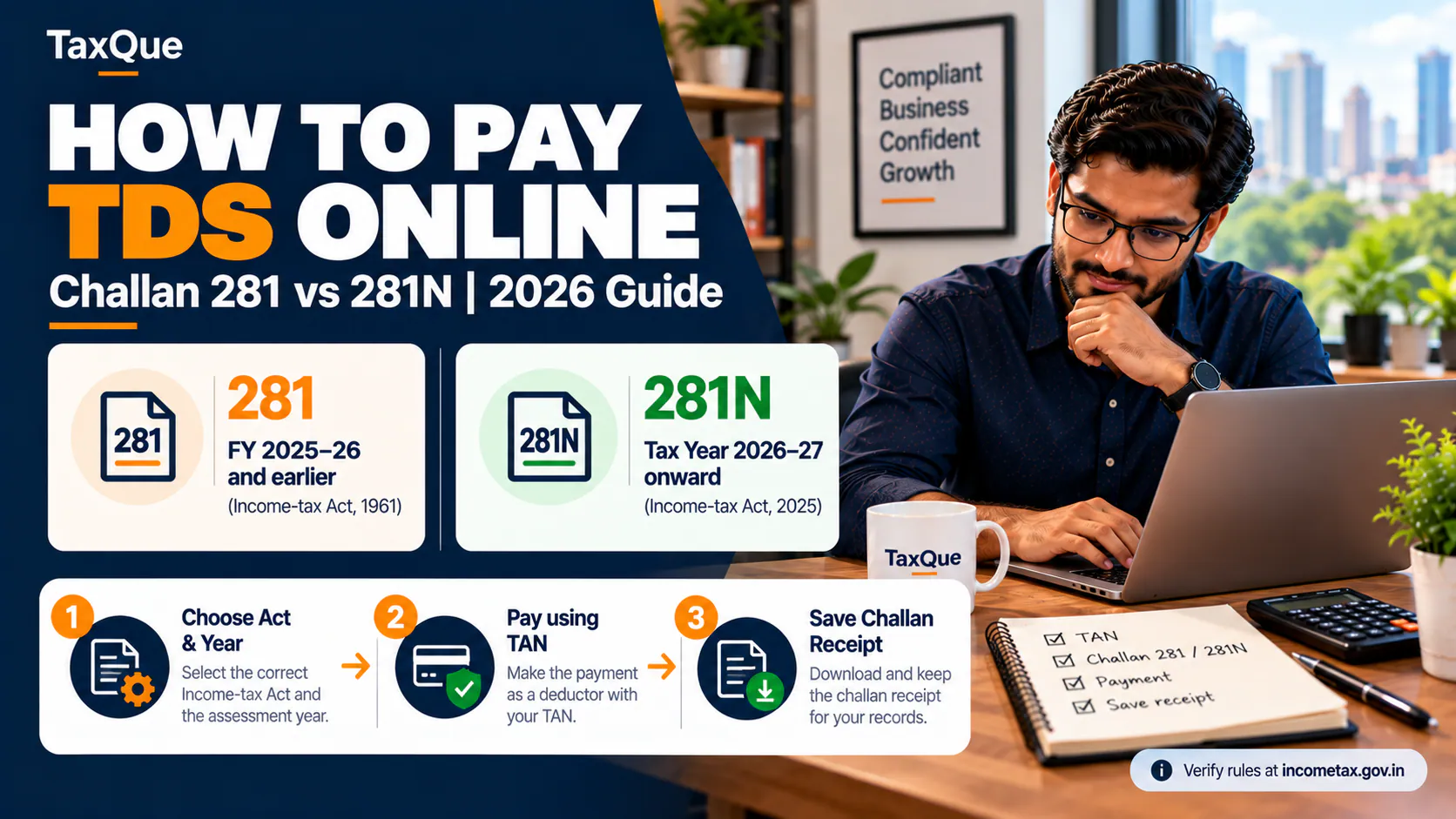
FY 2025–26 / AY 2026–27 and earlier saved periods remain under the 1961 Act. Tax Year 2026–27, from 1 April 2026, uses the new Act. A correction filed today can still belong to an old-year framework.
Current ordinary statements include Form 138 for salary TDS, 140 for resident non-salary, 144 for non-resident reporting and 143 for TCS. Relevant current certificates include 130, 131, 132 and 133, depending on the transaction. Their timing is not identical.
Use the official form and transition guidance Official ↗ and 2026 Rules Official ↗.
Three separate completion checks
- Tax calculated correctly: the actual entry, status, threshold, base, rate and trigger were checked.
- Money paid correctly: the right Act, period and deductor/collector identity appear on the successful payment record. Ordinary deposit duties should not be postponed until a quarterly statement date.
- Reporting and credit reconciled: the correct statement is processed and the prescribed certificate is issued where required.
Recipients should reconcile credit rather than claiming a refund solely because TDS or TCS appears on a certificate. Missing credit can require the payer/collector to correct the underlying reporting.
Keep GST TDS/TCS separate
GST also uses the terms TDS and TCS, but those mechanisms have different registrations, returns, credits and conditions. Income-tax collection on scrap, GST reverse charge and GST TDS are separate questions. The same numerical percentage does not make them one deduction.
Contact TaxQue with the transaction, parties' status and tax period for a scoped review. Keep the invoice, tax calculation, payment acknowledgement and certificate together.