Updated on 8 Nov 2026
Your accountant says the TDS was paid. Then a supplier calls: “Why is the credit missing?” Both statements can be true. Paying TDS and filing the quarterly statement are different jobs. A payment receipt does not tell the department which supplier should receive that credit.
In 2026 there is another wrinkle: the familiar form numbers have changed for transactions covered by the new Income-tax Act. Here is a practical way to keep the right quarter, form and deadline together without turning your desk into a wall of reminders.
Old law vs new law: The Income-tax Act, 2025 applies to Tax Year 2026–27 beginning 1 April 2026. FY 2025–26 / AY 2026–27 and earlier remain under the saved 1961 Act. Choose provisions and forms by the income or deduction period, not the upload date.
First, separate the two calendars
The deposit calendar tells you when deducted money must reach the government. For an ordinary non-government deductor, that is generally the seventh of the following month, with a different March deadline.
The statement calendar tells you when the quarter’s deductee-wise information must be reported. Filing a statement late can leave a vendor struggling to reconcile credit even when the money was deposited on time.
The quarterly TDS dates at a glance
Section 397 and Rule 219 prescribe the current quarterly statement framework. For regular quarterly TDS statements, the standard timetable is:
| Quarter | Period in Tax Year 2026–27 | Standard statement deadline |
|---|---|---|
Q1 | April–June 2026 | 31 July 2026 |
Q2 | July–September 2026 | 31 October 2026 |
Q3 | October–December 2026 | 31 January 2027 |
Q4 | January–March 2027 | 31 May 2027 |
These are the ordinary TDS statement dates, not a universal schedule for every withholding-related form. Specified challan-cum-statements have their own timeline. TCS is a different obligation; do not automatically reuse an old TCS calendar or assume it is always fifteen days earlier.
As of this update, Q2’s standard date has passed. If your statement is pending, check for a notification covering your exact form and period, then regularise it promptly. This article does not assert a special extension: none has been independently established for your case.
Which form should you select?
The Income Tax Department’s official form-mapping guide identifies these equivalents:
| Purpose | Earlier framework | Income-tax Act, 2025 framework |
|---|---|---|
Salary TDS statement | Form 24Q | Form 138 |
Resident non-salary TDS statement | Form 26Q | Form 140 |
Non-resident non-salary TDS statement | Form 27Q | Form 144 |
TCS statement, a separate obligation | Form 27EQ | Form 143 |
Confirm payee status and payment type; mapping does not replace form instructions.
A worked example: paid on time, reported late
Imagine a small design agency deducted ₹10,000 from a vendor payment in September 2026. It deposited that amount on 7 October and kept the payment receipt.
The deduction belongs in Q2, July–September 2026. Assuming this is an ordinary resident non-salary deduction, the statement route is Form 140, with the standard filing date of 31 October 2026.
If the agency has not filed by 8 November, the deposit alone does not finish its compliance. It must reconcile the challan and vendor details, file the appropriate statement, and review processing. Any applicable late-filing consequences are separate from whether deposit interest arose.
The example is illustrative. It assumes the deduction itself was correctly calculated and no special filing relief applies.
TaxQue tip: Keep three separate proofs for each quarter: the deposit receipt, the statement acknowledgement and the processing/correction status. One green tick in accounting software should not stand for all three.
Your pre-filing checklist
- Identify the governing Act and quarter. Do not mix March 2026 deductions with April 2026 deductions merely because both deposits happened in April.
- Match the deductor’s TAN and the deductee’s details with the underlying records.
- Reconcile amounts deducted, amounts deposited and amounts allocated in the statement.
- Investigate differences rather than forcing totals to match.
- Use the latest utility/schema that supports the selected form and period.
- Validate the file, complete the required authentication and retain the acknowledgement.
- Check processing afterwards; an upload is not proof that every row has been accepted correctly.
A certificate cannot repair a wrong underlying statement.
What about corrections and quarters with no deductions?
A correction for an old quarter follows that quarter’s legal framework, even if submitted now. The department’s transition guidance specifically keeps corrections for periods governed by the 1961 Act in the old framework.
Do not submit a dummy “nil return” just because a reminder appeared. Whether a statement or a non-filing declaration is appropriate depends on the facts and the portal process. Record why no deduction arose, and confirm the applicable requirement instead of inventing zero-value deductee entries.
Watch out: Do not assume a weekend, a software problem or an extension for income-tax returns automatically extends a TDS statement deadline. Check the actual notification and retain it with your working papers.
Deposit, late fee and certificates in one place
| Item | Standard rule |
|---|---|
| TDS deposit (non-government deductor) | 7th of the following month; 30 April for March deductions |
| Current late-statement fee | Section 427; verify the statutory computation for the default |
| Interest: deducted but deposited late | 1.5% a month |
| Interest: not deducted when required | 1% a month |
| Salary certificate | Form 16 (old periods) → Form 130 (new law) |
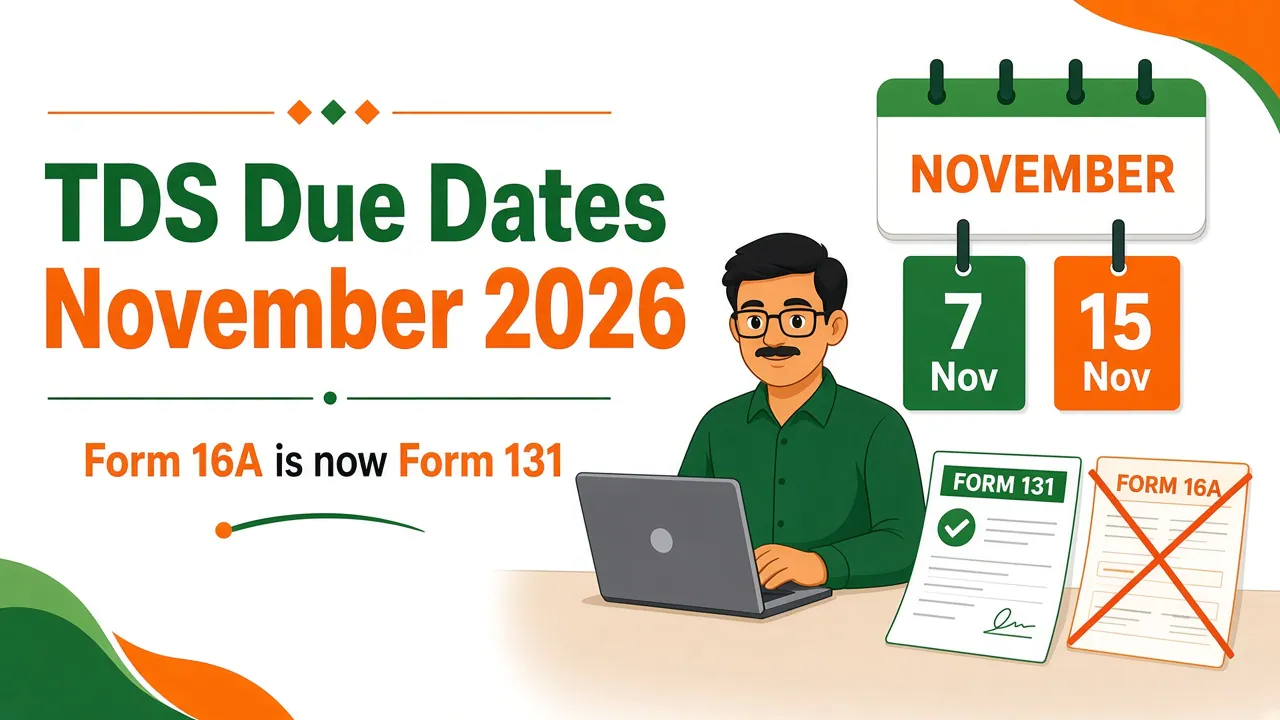
| Non-salary certificate | Form 131 for relevant deductions; Form 132 for specified challan-cum-statement cases |
| TCS statement | Form 27EQ (to March 2026) → Form 143 |
Under Rule 215, Form 130 is ordinarily due 15 June after the Tax Year; relevant Form 131 is due within 15 days after the quarterly statement deadline. Form 168 is the new-law annual information statement. Interest for defaults is addressed in Section 398.
Property-purchase TDS and certain rent or contract payments by individuals use transaction-wise challan-cum-statements, not the quarterly statement. Check the specific form and its own due date.
FAQs
Is depositing TDS enough to finish the quarter?
No. Regular deductors also need the correct quarterly statement and the applicable certificates. Deposit, reporting and certification are related but separate steps.
Can I still use Form 26Q in November 2026?
It may remain relevant for an old-law period or correction. For new-law resident non-salary reporting, the official mapping identifies Form 140. Select the period and Act first.
Is the Q4 statement due on 30 April?
Not under the standard regular TDS statement timetable: Q4 is ordinarily due on 31 May. The 30 April date is generally the March deposit deadline for non-government deductors.
What if my supplier cannot see the credit?
Compare the statement’s deductee details, challan allocation and processing status with your records. Correct the underlying mismatch where necessary; simply sending the bank receipt may not resolve it.
References
- Notified Income-tax Rules, 2026: current sections, forms and timing Official ↗.
- Income-tax Act, 2025 as amended by Finance Act, 2026 Official ↗.
- Income Tax Department: transition FAQs, especially Topics 2 and 6 Official ↗
- Official form-mapping guide: old and new form numbers Official ↗
- Official Form 140 FAQ: quarterly deadlines and corrections Official ↗
- Income Tax e-filing portal: current notices and filing services Official ↗
Need the quarter checked? TaxQue can help reconcile deductions, deposits and statements before a mismatch becomes a vendor complaint. Contact info@taxque.in | 9311256088 | taxque.in. This is general guidance, not a substitute for advice on your records.