
Updated on 8 Nov 2026
It is the seventh of the month. Salaries are paid, vendors are chasing invoices and someone asks, “Did the TDS payment actually go through?” A bank debit is reassuring, but the real finish line is a successful tax payment recorded against the correct deductor, period and legal framework.
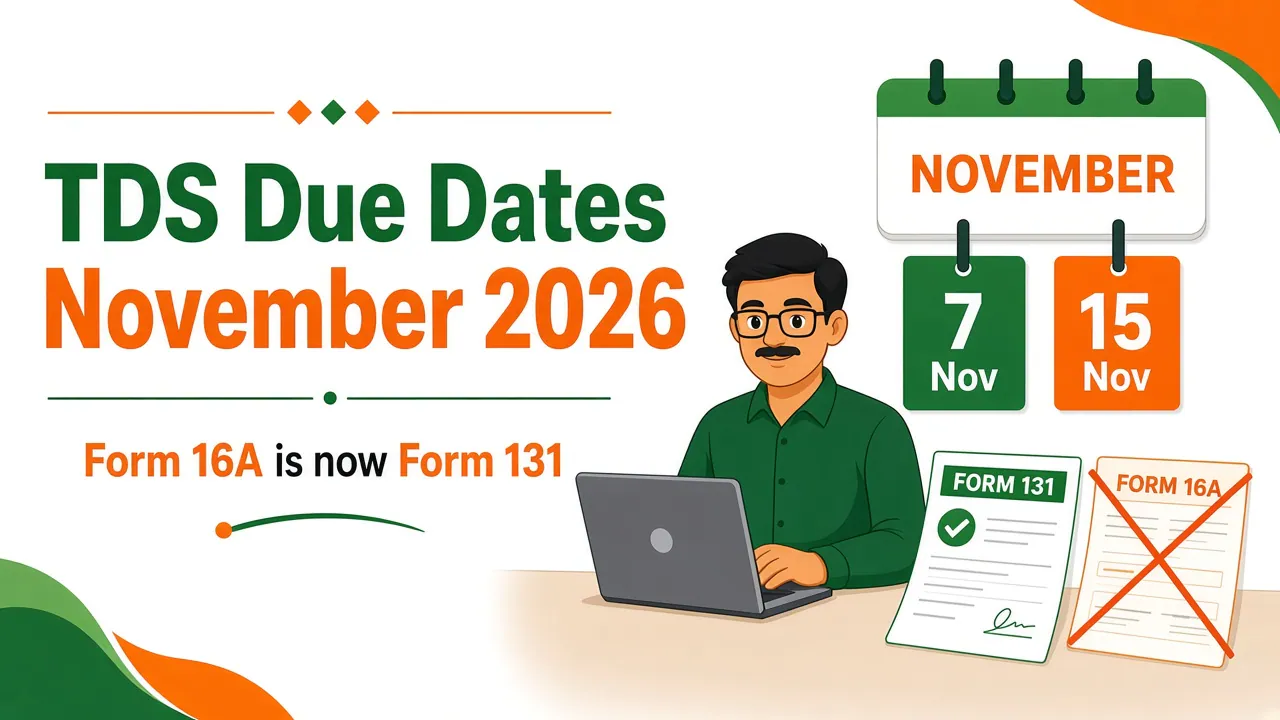
The simplest TDS rule is also the easiest to oversimplify: most ordinary non-government deductions are deposited by the seventh of the next month. March, government payments and specified challan-cum-statements need separate treatment. Here is how to manage those differences without relying on last year’s spreadsheet.
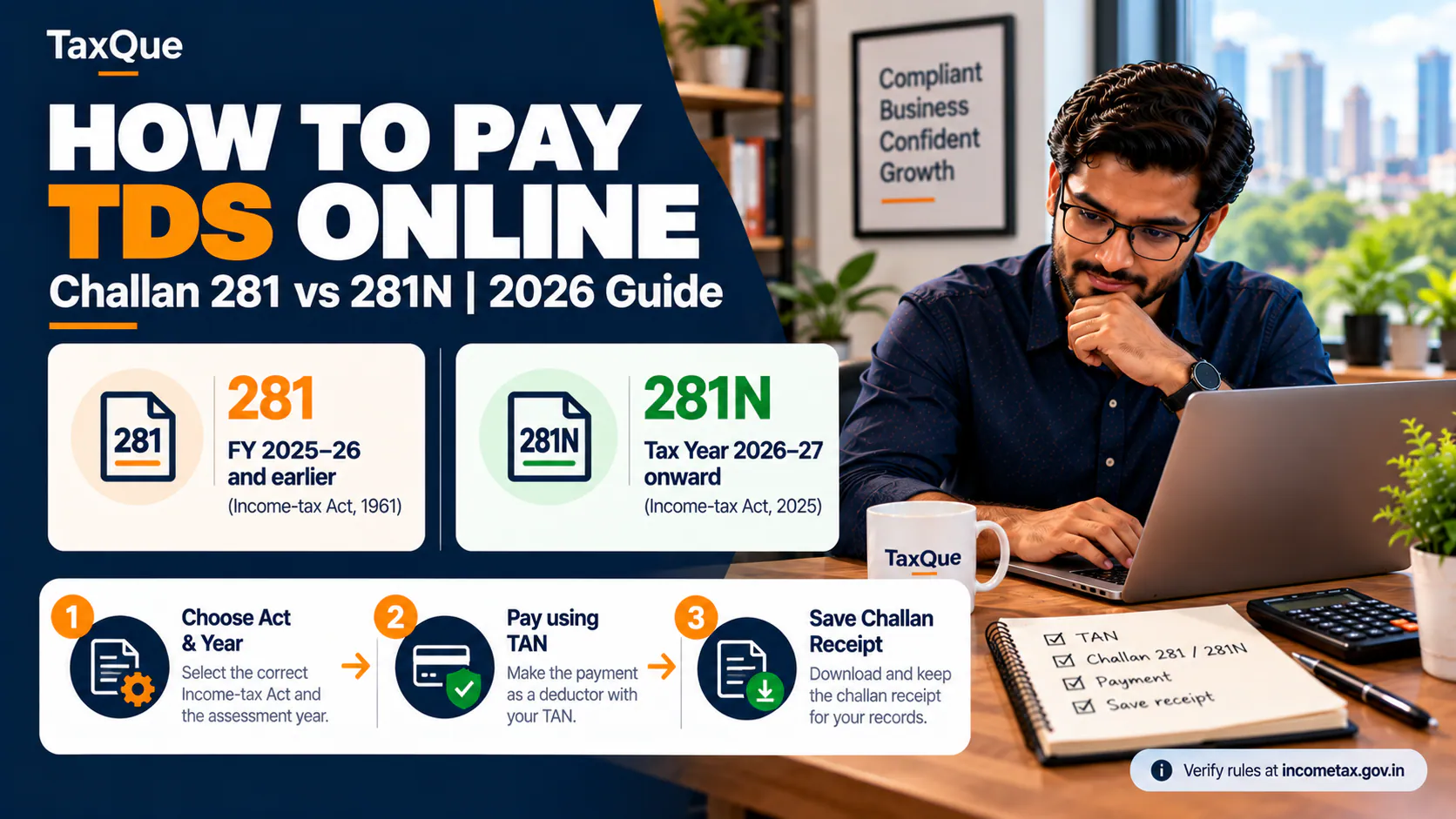
Old law vs new law: The Income-tax Act, 2025 applies to Tax Year 2026–27 beginning 1 April 2026. FY 2025–26 / AY 2026–27 and earlier remain under the saved 1961 Act. Choose provisions and forms by the income or deduction period, not the upload date.
Rule 218 governs deposits; Section 398 addresses interest for deduction/payment defaults. Section 392 is salary withholding; Section 393 covers other TDS categories.
The deadline table you can actually use
| Deductor or transaction | Standard deposit timing |
|---|---|
| Ordinary non-government TDS, April–February | Within seven days from the end of the deduction month |
| Ordinary non-government TDS, March | By 30 April following that March |
| Government deductor paying without a challan | On the same day |
| Government deductor paying with a challan | Within seven days from month-end |
| Specified challan-cum-statement transactions | Generally within 30 days from the end of the deduction month |
This table is not a substitute for checking whether a special approval or transaction-specific rule applies. In particular, do not give a government book-adjustment payment the ordinary non-government March deadline.
The challan-cum-statement category covers specified transactions such as certain property, rent, professional-payment and virtual-digital-asset deductions. Under the new framework, the official mapping identifies consolidated Form 141 in place of old Forms 26QB, 26QC, 26QD and 26QE.
Upcoming ordinary deposit dates
For non-government deductors following the usual monthly rule:
| Deduction month | Standard deposit deadline |
|---|---|
| October 2026 | 7 November 2026 |
| November 2026 | 7 December 2026 |
| December 2026 | 7 January 2027 |
| January 2027 | 7 February 2027 |
| February 2027 | 7 March 2027 |
| March 2027 | 30 April 2027 |
On 8 November 2026, October’s ordinary deadline has already passed. If you have not paid, check whether a specific notification applies and calculate the consequences from the actual deduction and payment dates. Do not change the recorded deduction date to make a late payment appear timely.
Which Act does the payment belong to?
The Income-tax Act, 2025 came into force on 1 April 2026. That does not make every payment made after that date a new-law payment.
For an earlier-of-credit-or-payment TDS category, a liability triggered in March 2026 remains governed by the 1961 Act, even if deposited in April. A liability first triggered in April 2026 belongs under the corresponding new-law provision.
This matters when selecting the portal’s Act, period, payment category and reporting references. Use the available payment journey for the governing framework; do not blindly copy an old Challan 281 screenshot for every current transaction.
TaxQue tip: Add a “governing Act” column beside the deduction month in your payment tracker. It is a small change that prevents old-period liabilities being mixed into new-law reporting during the transition.
A worked example: why two calendar months can matter
Suppose an ordinary non-government deductor correctly deducts ₹10,000 on 20 October 2026 but deposits it on 10 November 2026. Its standard due date was 7 November.
The deposit is late. Under the department’s transition guidance, interest for failing to pay after deduction remains 1.5% for every month or part of a month, counted from deduction to actual payment.
On these assumptions, October and November are both involved: ₹10,000 × 1.5% × 2 = ₹300. It is not simply three days’ interest from 8 to 10 November. This illustration assumes the whole ₹10,000 remained unpaid and ignores any separate consequences.
Failure to deduct in the first place is a different default, generally carrying 1% per month or part for the relevant period. If both kinds of default occurred, identify the separate periods rather than applying one blanket calculation.
A five-minute payment control
- Reconcile the month. Compare the TDS ledger with salary and vendor entries, including year-end provisions where relevant.
- Confirm the category. Ordinary monthly TDS and challan-cum-statements do not share every deadline.
- Verify payment details. Check deductor identity, period, Act, amount and payment category before authorising.
- Complete the payment. A prepared challan or pending transaction is not successful remittance.
- Save and reconcile proof. Retain the receipt, bank entry and any reference needed for statement allocation.
Schedule an internal target before the statutory date. That buffer is useful when the bank is unavailable or an approver is travelling. It is a business control, not a legal extension.
Depositing tax is not filing the statement
A successful payment does not allocate every rupee to each employee or vendor. The appropriate statement supplies those details, and certificates follow the applicable process.
For current periods, use statements 138/140/144, or 143 for TCS, under Rule 219. Salary certificates are Form 130, relevant non-salary certificates Form 131, and specified challan-cum-statement certificates Form 132, under Rule 215.
Keep payment status, statement status and certificate status separate. That makes it much easier to answer a supplier who cannot reconcile credit and to identify whether the issue is payment, data entry or processing.
Watch out: Do not assume every Sunday, bank holiday or portal outage automatically moves a statutory date. Check the applicable legal rule or official notification. This guide does not confirm a special extension for October 2026 deductions.
FAQs
Does the seventh-day rule cover every TDS payment?
No. March deposits by ordinary non-government deductors, government book adjustments and specified challan-cum-statements need separate treatment. Check the category before using the date.
Is March TDS due on 7 April or 30 April?
For ordinary non-government deductions, generally 30 April. Government payments with a challan generally follow the seventh-day rule; without a challan, same-day payment applies.
Can I wait until the quarterly statement deadline to pay?
No. Deposit and statement obligations have different schedules. A later statement date does not postpone the earlier deposit liability.
What should I do after a payment fails?
Check its status before paying again, avoid an accidental duplicate, and complete the deposit through the authorised process. Keep the failure record, but do not assume it removes interest or changes the deadline.
References
- Notified Income-tax Rules, 2026: current sections, forms and timing Official ↗.
- Income-tax Act, 2025 as amended by Finance Act, 2026 Official ↗.
- Income Tax Department transition FAQs: deposit timelines, Rule 218 and interest Official ↗
- Official form mapping, including Form 141 Official ↗
- Income Tax e-filing portal Official ↗
Not sure your deposit is correctly allocated? TaxQue can review the period, payment category and reconciliation. info@taxque.in | 9311256088 | taxque.in. Examples are illustrative; obtain advice for your actual transactions.