A deductor is the person responsible under the relevant income-tax provision for withholding tax and completing the related payment and reporting duties. The deductee is the person whose income or payment bears that withholding and who may claim the applicable credit.
The roles depend on the transaction. A business can be a deductor when paying a supplier and a deductee when a customer withholds from its invoice. This guide was reviewed on 22 November 2026.
Who is on each side?
| Transaction, where the relevant TDS conditions apply | Deductor | Deductee |
|---|---|---|
Salary | Employer. | Employee. |
Bank-deposit interest | Bank. | Depositor receiving interest. |
Interest on a covered business loan | Borrower/payer. | Lender receiving interest. |
Covered professional invoice | Client/payer. | Professional or service provider. |
Covered resident property purchase | Buyer. | Seller receiving consideration. |
A lender is not automatically the deductor and a borrower is not automatically the deductee. Identify who pays the covered income and which provision assigns the duty.
Not every payer must withhold on every payment
Check the nature of income, recipient residence, payer category, trigger, threshold and exceptions. Some individual/HUF provisions use preceding-year turnover conditions; others cover specified transactions separately. “Tax audit done” and “personal payment” are not universal answers across all TDS provisions.
Salary withholding also differs from a vendor-payment rule. The employer estimates applicable annual salary tax; a salary receipt does not necessarily produce a deduction when the correct computation is nil. Do not use a ₹6 lakh salary example to imply tax must always be withheld.
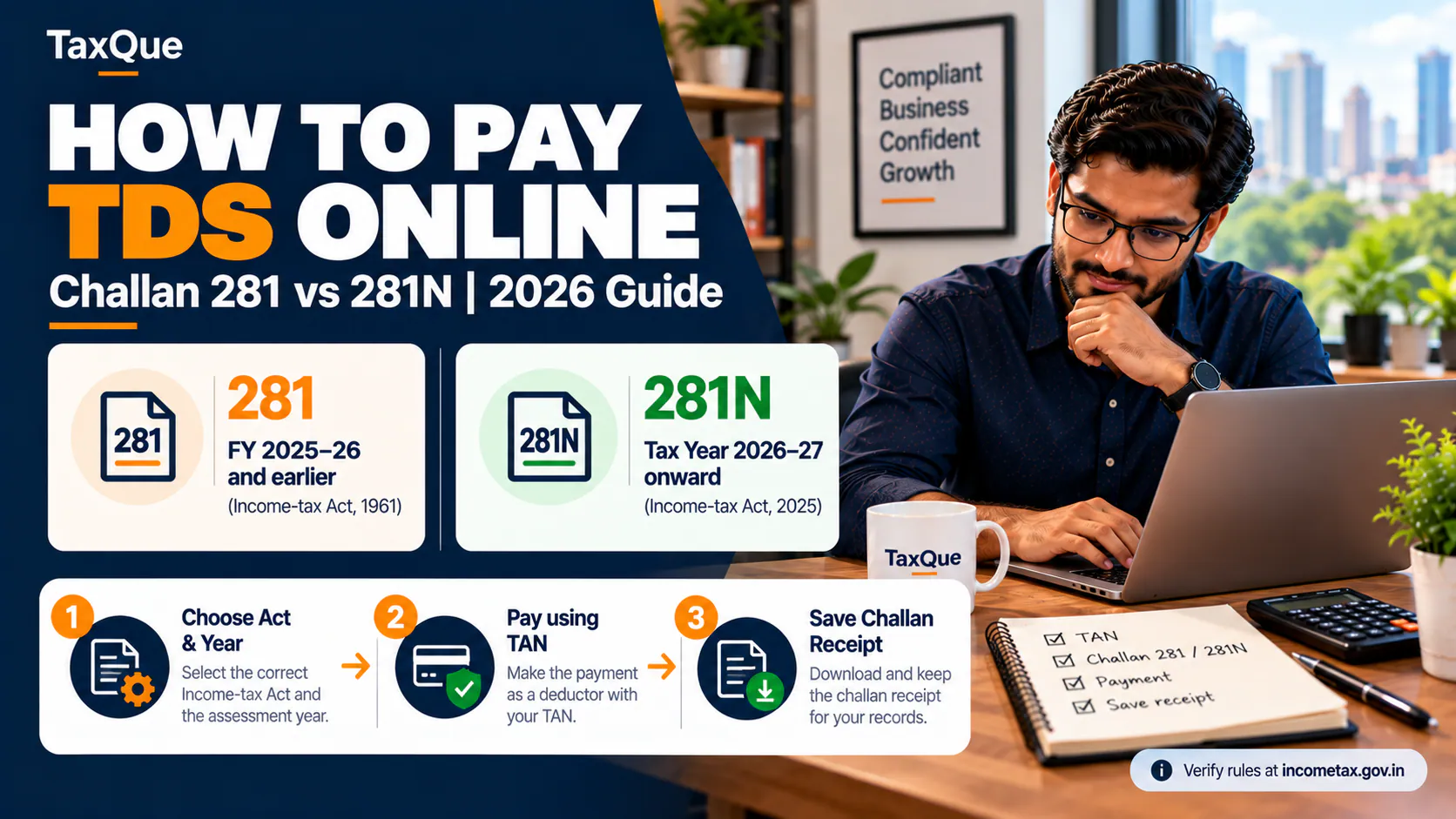
For current Tax Year 2026–27, salary starts with section 392 and other TDS categories with section 393. FY 2025–26 and earlier saved periods retain their relevant 1961 Act provisions. Official TDS transition guidance Official ↗.
TAN and PAN have different jobs
Ordinary deductors need the applicable TAN and must quote it in relevant payment and reporting records. The recipient's PAN identifies their income-tax record and credit; it does not replace the deductor's TAN in every ordinary transaction.
Specified PAN-based challan-cum-statement transactions are exceptions to the ordinary TAN route. Current Form 141 consolidates the relevant property, rent, high-value-payment and VDA categories. Do not assume that only companies or government offices need TAN, or that every individual must obtain one for a specified PAN-based transaction.
Current Form 141 manual Official ↗.
The deductor's completion checklist
- Determine the rule: document the payment, recipient residence, payer conditions, threshold, rate and trigger.
- Withhold correctly: record gross amount, deduction and net payable, with any relevant certificate or declaration.
- Pay the government: use the correct Act, period and payment route; retain successful payment evidence.
- Report the recipient's details: file the applicable statement and reconcile challan allocation, PAN and amounts.
- Review processing: resolve defects, defaults or mismatches and retain correction acknowledgements.
- Issue the right certificate: use the prescribed generated certificate and timing, rather than an informal deduction note.
For current ordinary statements, Form 138 covers salary, 140 resident non-salary and 144 non-resident reporting. Certificate timing differs: salary Form 130 is ordinarily due by 15 June after the tax year, while relevant Form 131 is due within 15 days after the quarterly-statement deadline. Specified transaction-wise cases use Form 132.
What the deductee should do
Report the correct gross income and reconcile the available credit against certificates and portal records. TDS is not automatically the final tax or an automatic refund.
If credit is missing, give the deductor the year, certificate, PAN and affected payment details through an appropriate secure channel. The underlying statement may need correction; the deductee cannot fix the deductor's PAN row merely by changing their own return.
An acknowledgement of a payment and a processed recipient-credit record are related but different evidence. Keep both where relevant.
Keep GST withholding separate
Income-tax TDS and GST TDS have different registrations, rules, returns and credits. The fact that someone is a GST deductor does not settle their income-tax withholding duties, and an income-tax TAN is not the GST TDS registration.
For the current payment route see the ITNS 281/281N guidance Official ↗; for statement and certificate requirements see the notified 2026 Rules Official ↗.
Ask TaxQue to review the reporting chain with the transaction and tax period. Avoid unsupported claims about what proportion of India's tax is collected by TDS; they are not needed to understand the role.