TDS on a service invoice is not always professional-fee withholding. A staffing contract, professional engagement, equipment lease, commission and payment to a non-resident can fall under different rules even when each invoice says “services”.
Read the contract before choosing the rate. This guide was reviewed on 22 November 2026 and uses the current Income-tax Act, 2025 framework, with saved old-law references kept separate.
Classify the work and the parties
| Payment | Current starting point |
|---|---|
| Covered resident contractor/subcontractor | Section 393(1), Table 6(i), with its work definition and payer conditions. |
| Covered resident professional/technical categories | Section 393(1), Table 6(iii). |
| Covered commission/brokerage | Section 393(1), Table 1(ii), rather than treating it as a professional fee automatically. |
| Employee salary | Section 392 payroll framework. |
| Non-resident supplier | Relevant section 393 non-resident provisions, including chargeability and any valid treaty analysis. |
| Certain high-value payments by individuals/HUFs outside ordinary specified-payer categories | The separate applicable entry and transaction-wise reporting requirements. |
Do not classify recruitment, advertising, coaching or IT work solely from the supplier's industry label. Contract terms and statutory definitions matter.
Professional and technical fee conditions
For the relevant ordinary resident categories, the annual threshold is ₹50,000, not the old ₹30,000 figure. Director remuneration covered by the non-salary entry has its own no-threshold treatment. Do not treat an employee director's salary as sitting fees merely because the recipient is a director.
The rate is generally 10% for professional fees and the applicable other categories, with 2% for specified technical-service and other specifically covered cases. The exact entry distinguishes the categories; a service being sophisticated does not by itself justify the 2% rate.
Current department TDS rate table Official ↗ · Section 393 framework Official ↗.
Check the payer before deducting
Companies and firms can have ordinary withholding duties, but each provision still has conditions. Individuals/HUFs need the relevant preceding-year turnover and category analysis. Do not replace that test with the statement “tax audit was done”.
Nor is personal use a blanket exemption from every withholding provision. A separate high-value-payment or rent provision can need consideration even when an ordinary business-payment rule does not apply.
For non-resident payments, “higher rate under the foreign-payment section” is not a sufficient conclusion. Establish whether the sum is chargeable and what the law and any supported treaty entitlement require.
Work through the invoice value
Assume a covered resident professional service has a ₹60,000 TDS base, the ₹50,000 condition is crossed, the normal 10% rate applies and no certificate or other exception changes the result. The illustrative deduction is ₹6,000, not 10% only on the excess over ₹50,000.
Where GST is separately indicated, apply the relevant CBDT guidance for that category to the TDS base. Reimbursements, material components and bundled supplies need their own analysis; an invoice label does not automatically exclude an amount.
Check PAN-related provisions and any valid lower/nil deduction certificate. A non-deduction declaration is available only for covered income and an eligible recipient, not for every professional invoice from someone expecting nil annual tax.
Deposit, report and certify under the correct framework
For many ordinary non-salary entries, deduction follows the earlier of credit or payment, subject to the entry's particular rules. Track both dates and any relevant year-end credit.
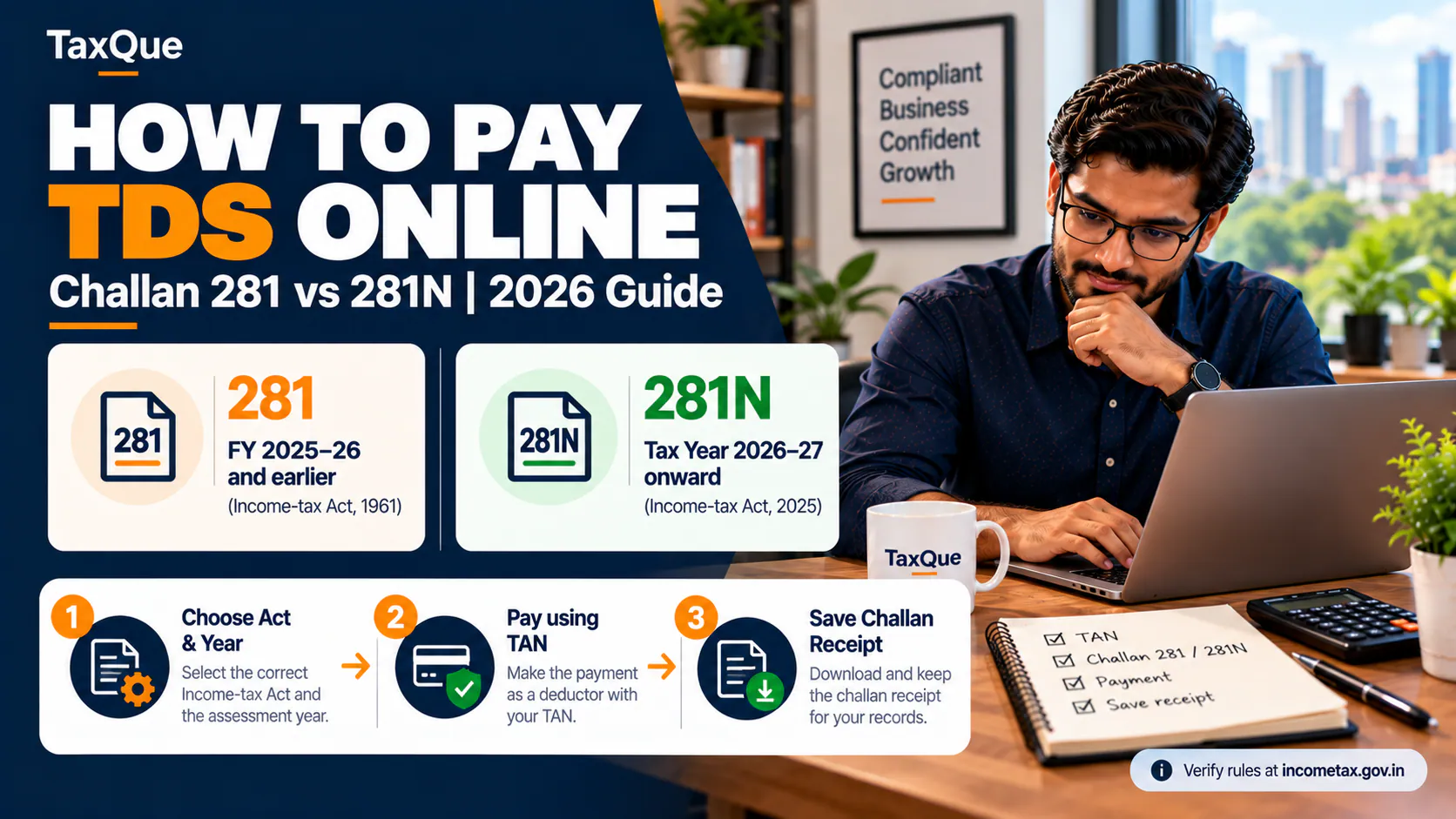
Current ordinary resident reporting uses Form 140 and the applicable Form 131 certificate. Saved FY 2025–26 periods retain their relevant Form 26Q/16A framework. Current payments use the supported new-Act route, including ITNS 281N where applicable; old-law payments use their corresponding route.
Official challan FAQ Official ↗ · Form 131 FAQ Official ↗.
Keep GST TDS separate
Income-tax TDS and GST TDS are different obligations. A GST TDS rule for a notified deductor and qualifying contract does not mean every business must deduct 2% GST TDS from every service invoice. Apply the relevant GST provision independently.
Retain the contract, classification conclusion, recipient residence, cumulative amount, tax calculation, payment and statement evidence together. If the wrong category was used, review the underlying reporting and available correction process rather than merely changing the next invoice's rate.
Contact TaxQue with the contract, year and parties' details for a scoped withholding review.