Section 194A is the familiar 1961 Act provision for TDS on covered interest other than interest on securities paid to residents. Its older ₹5,000/₹40,000/₹50,000 thresholds should not be reused for FY 2025–26.
From Tax Year 2026–27, use the corresponding section 393(1) interest entries under the Income-tax Act, 2025. This guide was reviewed on 22 November 2026 and distinguishes the periods.
Interest thresholds from 1 April 2025
| Covered payer/payment category | Ordinary annual threshold |
|---|---|
| Banking company, co-operative society carrying on banking, or qualifying notified post-office deposit: resident senior citizen | ₹1,00,000. |
| Same covered banking/post-office categories: other recipient | ₹50,000. |
| Other covered interest payments | ₹10,000. |
Check the statutory payer and deposit conditions. “Co-operative society” does not make every society identical to a co-operative bank. For banks using core banking, the threshold is not a fresh allowance at each branch.
The ordinary resident interest TDS rate is 10% where the relevant conditions are met. PAN-related provisions, valid lower/nil deduction certificates, eligible declarations and statutory exclusions need separate consideration.
Department's section 194A text Official ↗ · Current section 393 interest entries Official ↗ · Current TDS rate reference Official ↗.
Check who has to deduct
Under the saved section 194A framework, individuals/HUFs have a preceding-year business/professional turnover test: exceeding ₹1 crore for business or ₹50 lakh for profession. Do not replace that test with a statement that the payer is covered only when a tax audit actually occurs. The tax-audit threshold and this withholding test are different provisions.
Current section 393 uses its specified-payer framework for the relevant other-interest entry. Review the actual definition and payee residence. Interest paid to a non-resident needs the non-resident analysis rather than automatic use of this resident-interest table.
The threshold is not a deductible allowance
Assume covered bank-deposit interest of ₹60,000 for a non-senior resident, with a valid PAN, ordinary 10% treatment and no applicable exception. The ₹50,000 threshold is crossed; the example's deduction is ₹6,000, not 10% only on the ₹10,000 excess.
For a qualifying resident senior citizen receiving ₹60,000 from that covered category, the ₹1 lakh withholding threshold is not crossed. That does not make the interest tax-exempt: the person's final income-tax computation is separate.
Keep expected interest as well as credits already posted under review. Splitting deposits across branches of the same CBS bank does not create separate thresholds.
Exclusions and declarations need evidence
Savings-bank interest, particular payees and specified schemes can have distinct statutory treatment. Check the actual exclusion instead of labelling all government-scheme interest exempt from tax or TDS.
An exclusion from section 194A also does not mean every payment is free of withholding under another provision. In particular, firm-to-partner interest needs the relevant partner-payment rule.
For saved eligible declarations, Forms 15G/15H have their own residence, age and estimated-tax conditions. For Tax Year 2026–27, the department identifies Form 121 under the current framework. Age 60 alone is not a direction to submit a declaration regardless of taxable income. Official form-transition FAQ Official ↗.
Complete the reporting chain
For covered non-salary categories, deduction generally follows the earlier of credit or payment under the applicable provision; a suspense-account label does not necessarily postpone the trigger. Deposit, statement and certificate duties follow separately.
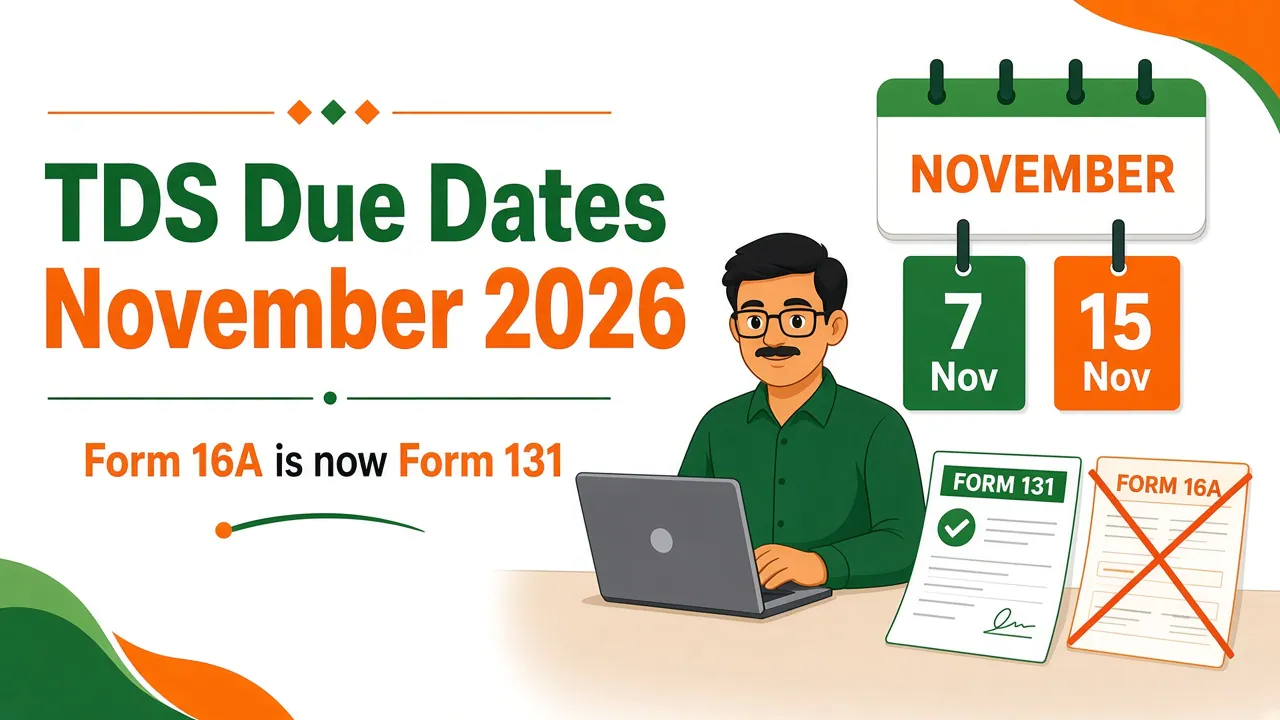
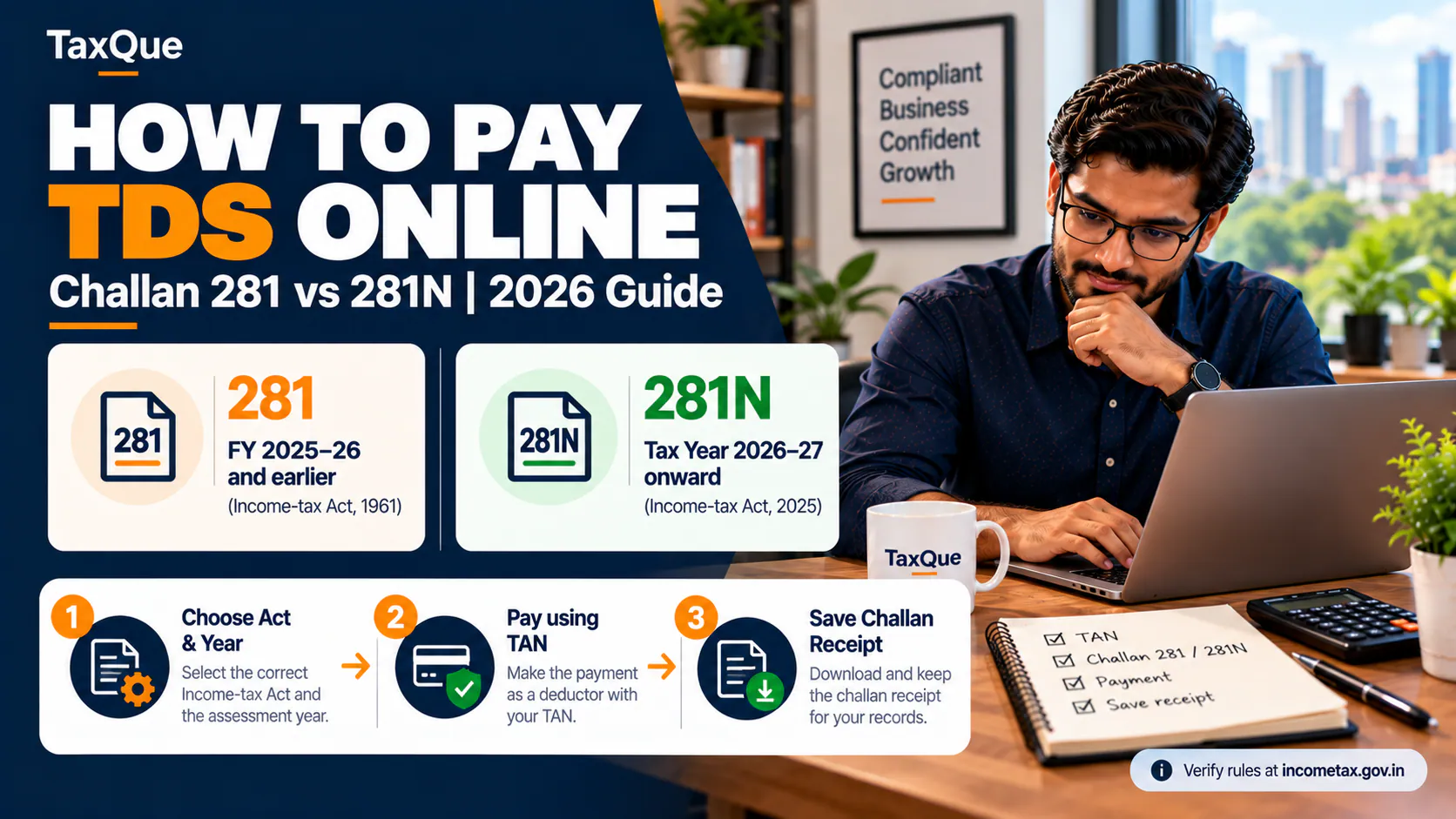
Saved FY 2025–26 resident statements use the relevant old-law Form 26Q/16A framework. Current ordinary resident reporting uses Form 140 and the applicable Form 131 certificate. Use the correct Act and period in the payment workflow rather than choosing a form by its familiar name.
Contact TaxQue with the payer type, recipient residence, year and interest total for a scoped review. Recipients should report the correct gross interest and reconcile TDS credit; the withheld amount is not necessarily their final liability.