Understanding Patta Chitta: Your Guide to Land Records in Tamil Nadu
TaxQue
Reviewed by TaxQue Legal & Compliance Experts
Quick Summary
The short version
If you’re a landowner or planning to buy property in Tamil Nadu, understanding Patta Chitta is vital. This document acts as proof of land ownership, playing a key role in property transactions, legal disputes, and tax assessments. By combining two older record…
Introduction
If you’re a landowner or planning to buy property in Tamil Nadu, understanding Patta Chitta is vital. This document acts as proof of land ownership, playing a key role in property transactions, legal disputes, and tax assessments. By combining two older records—Patta and Chitta—into one, Tamil Nadu has made it easier to manage land records. With the state’s e-Services portal, accessing these records is now quick and transparent. In this blog, we’ll explain what this document is, how to access it online, and why it’s important for property owners.
What is Patta Chitta?
This land revenue record, introduced in 2015, merges the Patta and Chitta documents into a single record. It provides detailed information about a piece of land, serving as a crucial document for proving ownership.
Patta: A legal record listing the owner’s name, land area, survey number, and location details like district, taluk, and village.
Chitta: Once a separate record, it included land classification (wetland or dry land) and ownership details.
The merger simplifies land record management, ensuring clarity and reducing disputes. It’s widely used for property sales, inheritance, and legal proceedings.
Why is This Document Important?
This record is a legal safeguard for landowners, offering multiple benefits:
Proof of Ownership: It confirms the legal owner, protecting against fraudulent deals.
Property Transactions: Buyers check it to verify the seller’s ownership before purchasing.
Tax and Legal Uses: It supports land tax assessments and helps resolve court disputes.
Land Classification: Details like wetland (nanjai) or dry land (punjai) clarify land use and value.
Tamil Nadu’s shift to digital records makes accessing this document easier, streamlining property management for owners.
How to Access Land Records Online
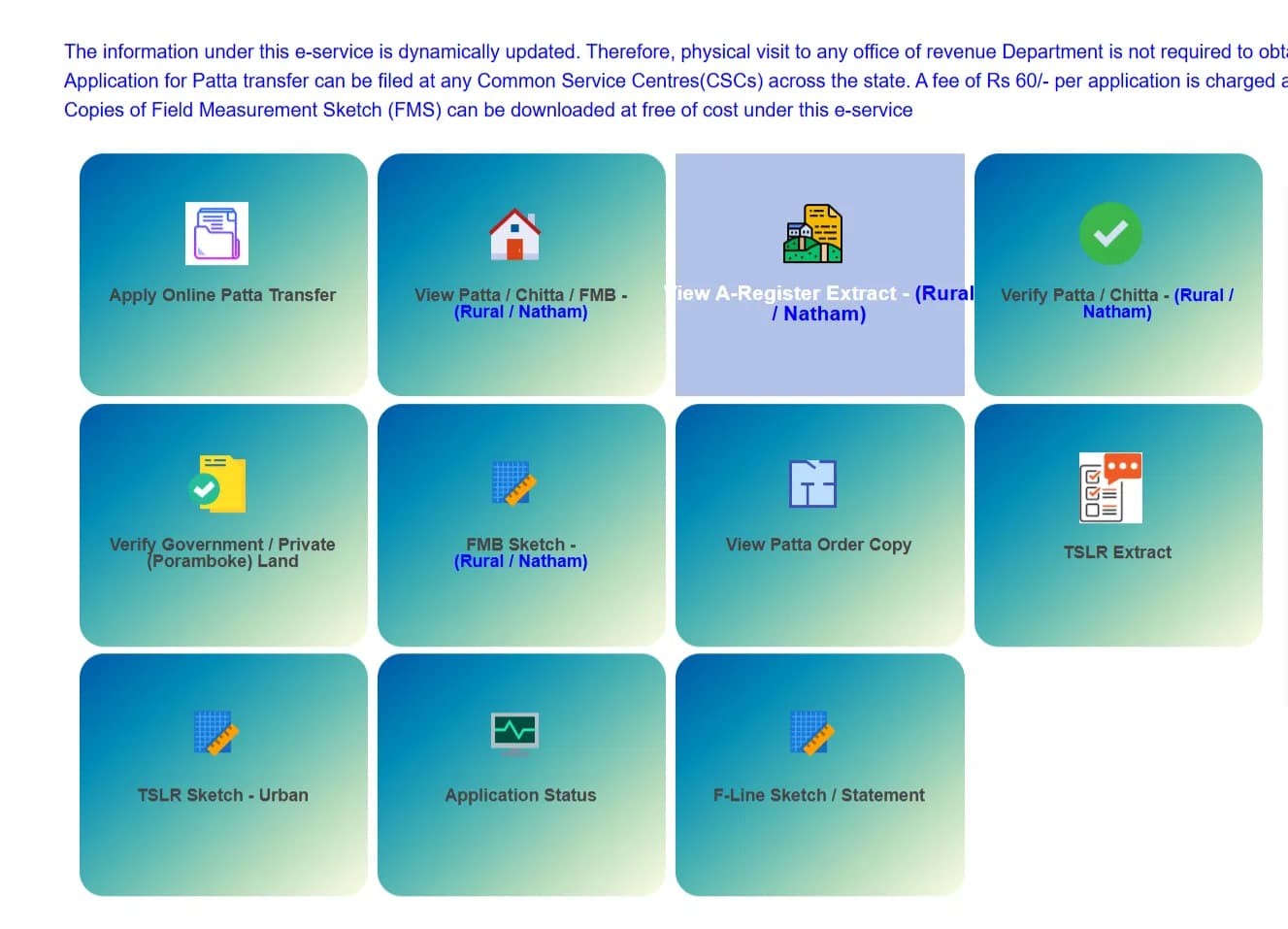
The Tamil Nadu government’s e-Services portal allows you to view, download, or verify land records. Here’s a step-by-step guide:
Visit the Portal: Access the official Tamil Nadu e-Services website.
Enter the reference number from the A-Register extract.
Submit to view verification details.
Transfer Process:
Apply at the Taluk office with documents like the sales deed, encumbrance certificate, and property tax receipt.
After processing, updated details appear online with an Application ID.
Note: Name changes are currently offline, requiring a visit to the Taluk or Village Administration Office.
Key Details in the Document
Detail
Description
Owner’s Name
Legal owner of the land.
Survey Number
Unique identifier for the land parcel.
Land Area
Size of the land in hectares or acres.
Classification
Wetland (nanjai) or dry land (punjai).
Location
District, taluk, village, and subdivision details.
Tax Details
Information on land revenue or tax obligations.
This table outlines the core components of the document, making it easier to understand its contents.
Land Record Management
For efficient management of land records, the Tamil Nadu government’s e-Services portal is highly recommended. Its user-friendly interface simplifies applying, verifying, and downloading records, ensuring compliance with state regulations.
FAQs
What is the difference between Patta and Chitta? Before 2015, Patta recorded ownership, while Chitta detailed land classification. They are now merged into a single document for ease of use.
Can I access these records online for free? No, a fee of ₹100 is charged to view or download records on the e-Services portal.
How long does it take to transfer ownership? Transfers typically take 15–20 days after submitting documents at the Taluk office, depending on verification.
Is this document mandatory for land registration? It’s not currently mandatory but strongly advised. The government may require it in the future to improve transaction security.
What if my record has incorrect details? Visit the Taluk or Village Administration Office with proof of ownership to request corrections, which may take a few weeks.
Conclusion
Patta Chitta is a vital tool for land ownership in Tamil Nadu, providing legal proof and detailed land information. The e-Services portal makes accessing and verifying these records straightforward and transparent. Whether you’re buying property, settling disputes, or handling taxes, this document is essential. By leveraging the e-Services portal, you can manage your land records confidently and protect your property rights.
This article is published by TaxQue (ARB FinTech LLP) for general informational, educational, and business guidance purposes only. Tax laws, GST rules, MCA circulars, and judicial precedents are subject to frequent statutory revisions. This content does not constitute formal individualized tax, accounting, or legal counsel.
Telangana and Andhra Pradesh still share the professional tax structure they had before the 2014 split: nothing up to ₹15,000 a month, ₹150 up to ₹20,000 and ₹200 above that. Emplo…
Karnataka has one of the simplest professional tax slabs: nothing below ₹25,000 a month, ₹200 a month above it. Since the 2025 amendment, February is ₹300, bringing the year to the…
You've filed a PF withdrawal or transfer and the money hasn't arrived. The claim status tells you where it is stuck: with your employer, under process at EPFO, settled, or rejected…
From company registration and GST filings to annual MCA audits and tax planning, TaxQue provides complete consulting solutions for startups and enterprises.