
2026 quick answer: A new Importer-Exporter Code (IEC) costs ₹500 in DGFT government fees. It is the basic identification code for most commercial importers and exporters—not blanket permission to trade every product. Restricted goods, SCOMET items and products regulated by other authorities may require additional permissions and fees. Check the exact product's 8-digit ITC(HS) code before paying a supplier or booking cargo.
An online search for import export licence fee in India can show surprisingly different prices. That happens because the IEC application fee, product-specific authorisation fee, professional charges and shipment costs are separate. Here's how to tell which ones apply to your business.
Import export licence fees in India: quick comparison
| Requirement | When it applies | Government fee or cost basis |
|---|---|---|
New IEC registration | Most commercial importers and exporters | ₹500 |
Annual IEC confirmation | IEC holders during April–June | Nil during the prescribed window |
Restricted export / SCOMET authorisation | Where the product and transaction require DGFT approval | ₹1,000 application fee under Appendix 2K for the specified category |
Restricted import licence / permission | Where the ITC(HS) import policy requires an authorisation | ₹1 per ₹1,000 (or part) of applicable CIF value; minimum ₹500, maximum ₹1 lakh, under the listed entry |
Other product approvals | E.g., relevant food, drug, safety, plant or wireless controls | Fees vary by regulator and activity |
Professional assistance | Optional help preparing applications and replies | Provider-specific, not a DGFT government fee |
The amounts above refer to the relevant entries in DGFT Appendix 2K Official ↗. The exact application category and fees shown in the live portal control your transaction; exemptions or subsequent amendments may apply.
IEC versus import/export authorisation: what's the difference?
IEC (Importer-Exporter Code) identifies the business for foreign-trade procedures. It is PAN-linked and generally remains valid unless suspended, cancelled or deactivated. Registration alone does not establish that a shipment is legally permitted.
A product-specific authorisation is separate permission needed for certain goods or transactions. For example, an exporter may hold a valid IEC but still be unable to export a restricted or SCOMET-controlled item without the relevant authorisation.
| IEC | Product-specific authorisation |
|---|---|
| Business identification | Permission for specified goods, quantities or conditions |
| Generally one IEC per PAN | Separate authorisations can be needed for different consignments/categories |
| ₹500 application fee | Fee depends on authorisation type |
| Annual details must be confirmed | Validity and conditions depend on the approval |
Think of IEC as your business's trade identifier and a restricted-goods licence as permission for a particular controlled trade. Neither removes customs or product-regulator obligations.
How to check if your goods need a licence
Check your product before shipping
-
Find the 8-digit ITC(HS) code
Use the precise product specification and relevant customs classification; verify with an experienced customs professional where uncertain.
-
Read the DGFT import or export policy
Check the latest ITC(HS) entry, associated policy conditions, notifications and any country-specific restrictions.
-
Identify the policy category
Free, Restricted, Prohibited, State Trading Enterprise (STE) or another conditional status can require different treatment.
-
Check other regulators
Determine whether BIS, FSSAI, CDSCO, plant/animal quarantine, WPC or other approvals apply to the actual product.
-
Confirm fees and documentation
Only then apply for IEC, the necessary authorisation and shipment documents.
A product listed Free under DGFT policy does not usually need a DGFT product-specific licence, but may still require approvals, standards compliance or customs documentation. Restricted means trade is possible only with the relevant permission and conditions. Prohibited generally cannot be traded unless a specific legal exception is available. STE items can be subject to authorised trading-channel rules.
Check the DGFT portal Official ↗ and the current Foreign Trade Policy 2023 Official ↗, as amended; do not rely solely on an online tariff-rate chart.
What does the ₹500 IEC registration fee include?
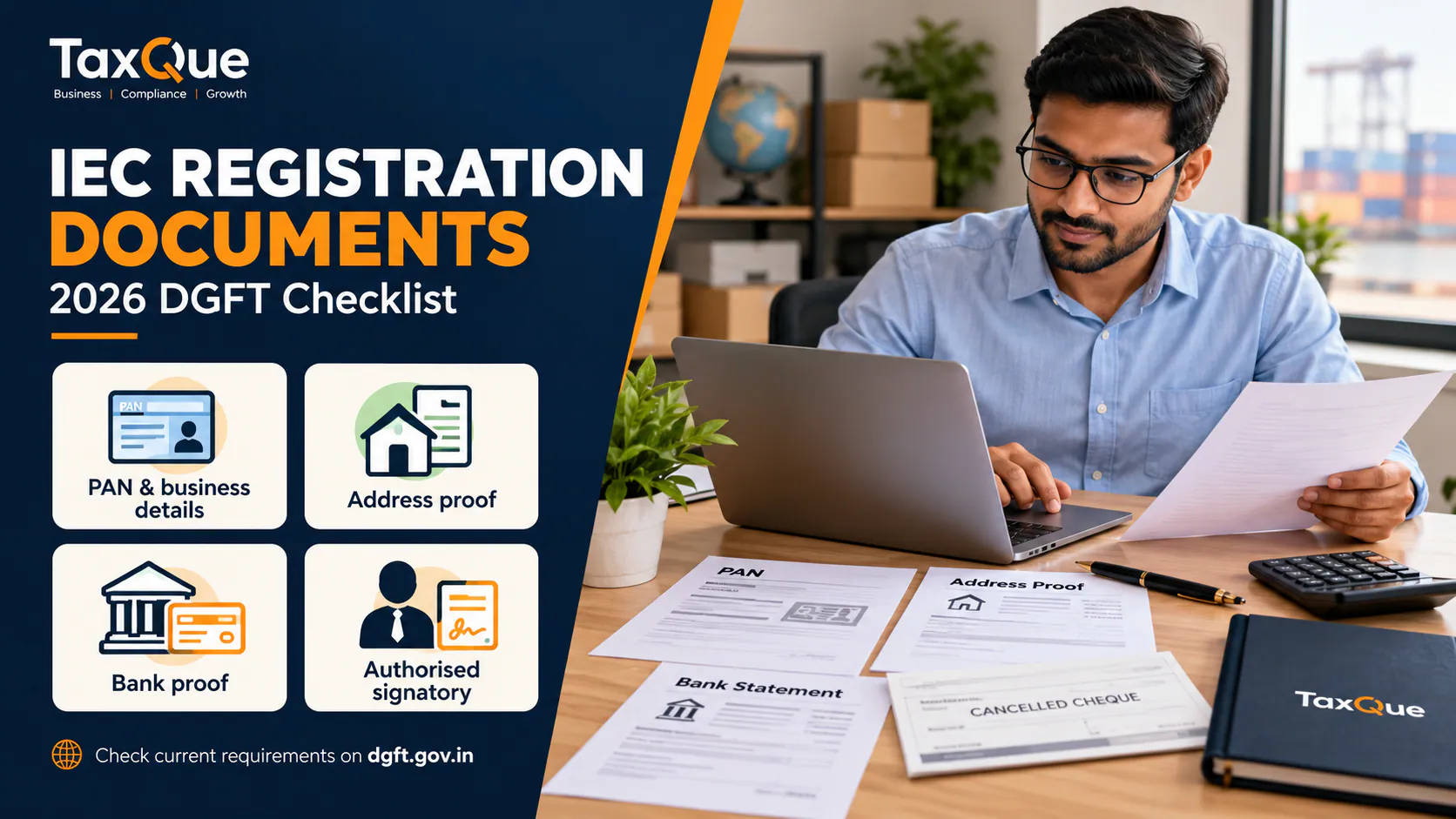
The ₹500 is DGFT's application charge, not a package including customs clearance, shipping, GST registration or product-specific licences. IEC applications are submitted online through the DGFT portal. Have the applicant's correct PAN-linked particulars, business address evidence, bank details and authorised signatory information ready.
A basic route is:
- Create or access the business profile on DGFT Official ↗.
- Select IEC issuance and complete the current online application.
- Review the legal name, PAN, address, bank details and attachments requested.
- Authenticate using the method provided on the portal and pay ₹500.
- Save the acknowledgement and IEC details; check that the issued record matches business documents.
The live application may validate some information electronically. Any mismatch can trigger an error or verification, so do not assume that payment guarantees immediate successful issuance.
For a document checklist, see TaxQue's IEC registration service, which can help with eligibility and application preparation.
Worked example: restricted-import application cost
Suppose an importer needs an authorisation under the value-linked restricted-import fee category and the relevant CIF value is ₹20 lakh.
- Applicable value: ₹20,00,000
- ₹1 per ₹1,000: ₹2,000
- Restricted-import application fee: ₹2,000, subject to the appropriate category and current schedule
- New IEC fee, if the business does not already hold an IEC: ₹500
Illustrative DGFT application charges: ₹2,500. This is not the total landed cost. Customs duties, IGST, freight, clearance charges and other approvals are outside the example. A product falling under a different DGFT scheme may have a different fee basis.
Other charges importers and exporters should budget for
| Cost | Why it may arise |
|---|---|
| Customs duty, IGST and other levies | Based on product classification, valuation and applicable exemptions |
| Freight, insurance and port handling | Charged by logistics providers and carriers |
| Customs broker | Documentation, classification and clearance support |
| Testing, inspection or certification | Required by product rules, buyer specifications or destination country |
| RCMC membership | May be relevant for specified export-promotion benefits or sector programmes |
| Certificate of Origin | May be needed for preferential tariff treatment or buyer requirements |
| Bank and AD-code-related procedures | Relevant banking and customs-system requirements for exports |
| GST compliance and LUT | Applicable GST obligations; eligible exporters may furnish LUT for zero-rated exports without upfront IGST payment |
Professional fees should be shown separately. For example, an IEC application package may include document review and filing support but exclude customs brokerage, RCMC membership, product licences and post-registration GST work. Ask for a written scope before accepting a quotation.
For eligible zero-rated supplies, see TaxQue's GST LUT filing support.
IEC validity and the annual update requirement
IEC is not an ordinary annual licence that expires every 12 months. However, the Foreign Trade Policy requires holders to confirm or update IEC information online during April–June each year, even if no particulars changed. The prescribed annual confirmation in this window carries no DGFT fee.
Failure to complete the required update can lead to deactivation. Successful updating can restore an IEC deactivated for that reason, subject to other restrictions or pending issues. Also update important business particulars promptly when they change; do not wait for the next annual window.
An IEC that exists on paper but is currently deactivated is not equivalent to an active IEC. Check the status on DGFT before scheduling shipments. Any out-of-window charge should be verified from the applicable live DGFT service, rather than assumed to be an annual renewal fee.
Common mistakes that increase costs
- Assuming ₹500 covers all permissions: It covers a new IEC application only.
- Selecting the wrong ITC(HS) code: An incorrect classification can lead to the wrong policy treatment or unexpected border charges.
- Treating “Free” as “no compliance”: Another ministry's approvals may still apply.
- Buying goods before checking restrictions: A later licence refusal can leave goods or advance payments at risk.
- Mixing government and consultant fees: Ask for separate itemised charges.
- Forgetting annual IEC confirmation: Deactivation may interrupt import/export operations.
Before you pay: final checklist
- ○ Confirm the applicant's existing IEC and status
- ○ Identify the exact 8-digit ITC(HS) code
- ○ Check the current import/export policy and product conditions
- ○ Decide whether a separate restricted/SCOMET authorisation is required
- ○ Verify the applicable Appendix 2K fee and any exemption
- ○ Check other regulators and destination-country requirements
- ○ Get separate estimates for tax, freight, bank and professional costs
- ○ Keep fee receipts, licences and shipment documents together
Official sources and next steps
Use primary government sources when checking charges or filing an application: DGFT Official ↗, Appendix 2K — user charges Official ↗, and the Foreign Trade Policy 2023 Official ↗. Check their current amendments for the transaction date.
If you need assistance checking which registrations are required and preparing the IEC application, TaxQue provides IEC registration assistance.
This guide explains general Indian foreign-trade requirements as at October 2026; licences and permissions depend on the exact goods, destination and trade conditions. Obtain transaction-specific confirmation before shipping.