A private limited company's annual compliance file should answer three questions: what applied during the year, what was approved at the meetings, and what was actually filed. A payment receipt alone does not answer all three.
This checklist was reviewed on 22 November 2026. It separates ordinary Companies Act timelines from the temporary filing relief for FY 2025–26, so an older calendar does not produce the wrong late-fee calculation.
Start with the company's position
Record the financial year, actual AGM date, auditor's appointment period and whether the company qualifies for a particular exemption or simplified form. Do not assume that low turnover alone makes it a small company: check the statutory definition and exclusions.
Keep the signed financial statements, Board's report, audit report, meeting records and statutory registers together. Check that the names, share capital and director details agree across the documents before preparing the returns.
Annual filings and meetings
| Item | Ordinary requirement to check |
|---|---|
| Financial statements | AOC-4 or the applicable variant, ordinarily within 30 days of the AGM. |
| Annual return | MGT-7; OPCs and qualifying small companies use MGT-7A. Ordinarily within 60 days of the AGM. |
| Auditor appointment | ADT-1, where required, within 15 days of the meeting appointing the auditor. It is not automatically a fresh annual appointment. |
| Board meetings | Ordinary rule: at least four in a year, with no more than 120 days between consecutive meetings; assess applicable relaxations. |
| AGM | The first AGM has a nine-month period from the close of the first financial year. Subsequent AGMs ordinarily have a six-month period and a maximum 15-month gap. |
Small companies have a relaxed Board-meeting framework: one meeting in each half of the calendar year, at least 90 days apart. Special rules also apply to OPCs; the meeting provisions do not apply in the same way to an OPC with only one director. An OPC is not required to hold an AGM. Use the rules for the actual company type rather than copying an ordinary private-company calendar.
FY 2025–26: apply the specific MCA filing relief
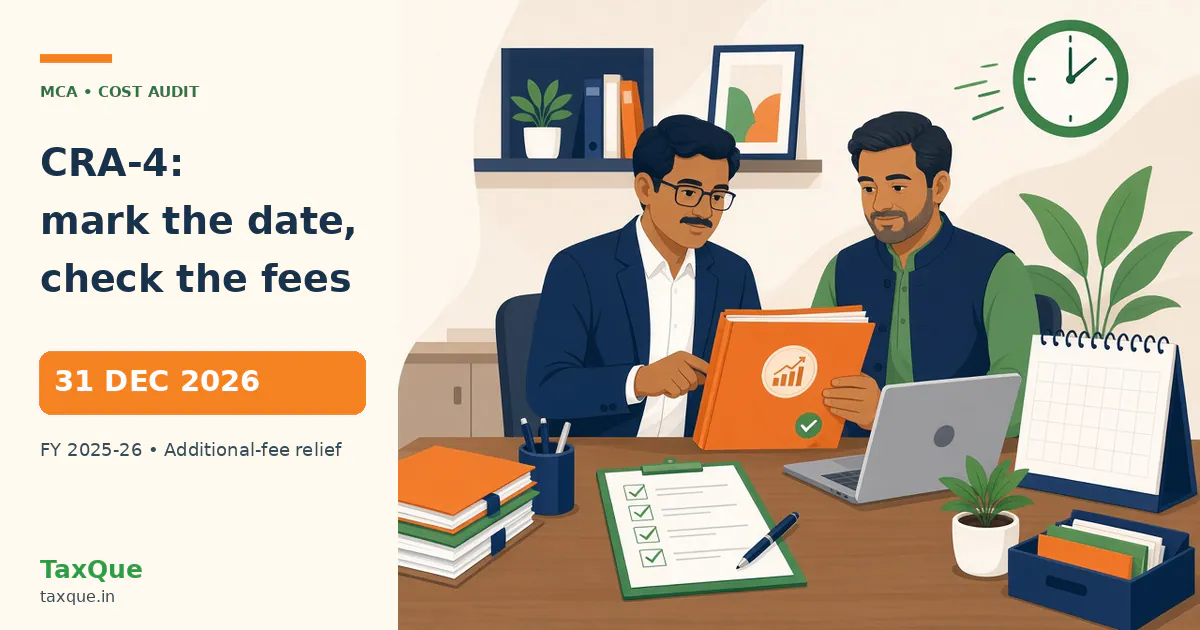
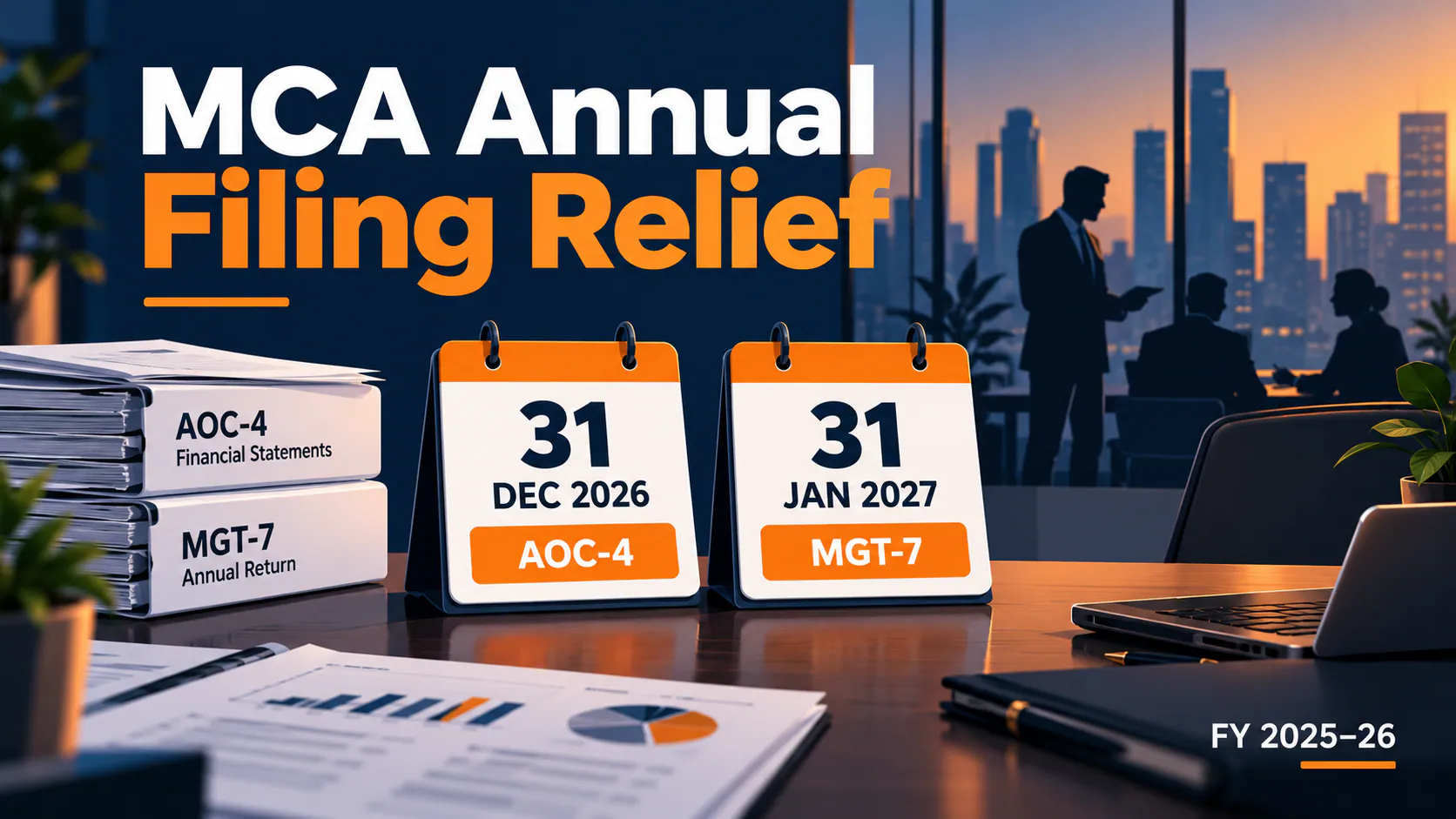
MCA General Circular 05/2026, dated 24 October 2026, permits the covered FY 2025–26 financial-statement forms to be filed up to 31 December 2026, and MGT-7/MGT-7A up to 31 January 2027, without additional fees. Normal filing fees remain payable.
The circular does not extend the statutory time for holding an AGM. Filings after its relief window attract the applicable fees from their original statutory due dates. Retain both dates in your calendar: the statutory deadline and the last date covered by the circular.
For example, if an eligible company's AOC-4 is filed on 5 November 2026, do not automatically multiply the days since its ordinary October deadline by ₹100. First apply the circular to the correct financial year and form. A generic late-fee example would be misleading here.
Director KYC is no longer an annual reminder for everyone
The revised framework took effect on 31 March 2026 and replaces annual KYC with an intimation once every three years. MCA's announcement says directors who had already completed KYC are next due by 30 June 2028. Changes to contact or address details, and DIN reactivation, need their own assessment; do not treat the three-year cycle as permission to leave incorrect details on record.
Keep a director-wise checklist showing DIN status, last compliance, registered contact details and any changes needing action.
Tax and other returns need separate checks
For FY 2025–26 / AY 2026–27, the saved Income-tax Act, 1961 applies. The extended audit-category income-tax return deadline of 21 November 2026 has passed as of this review. If a covered company has not filed, check the available filing route and consequences promptly. Different categories, including transfer-pricing cases, need their own deadline check. Companies generally use ITR-6 unless the ITR-7 category applies.
A Companies Act statutory audit and a tax audit are separate obligations. Do not assume that one audit report automatically completes the other filing.
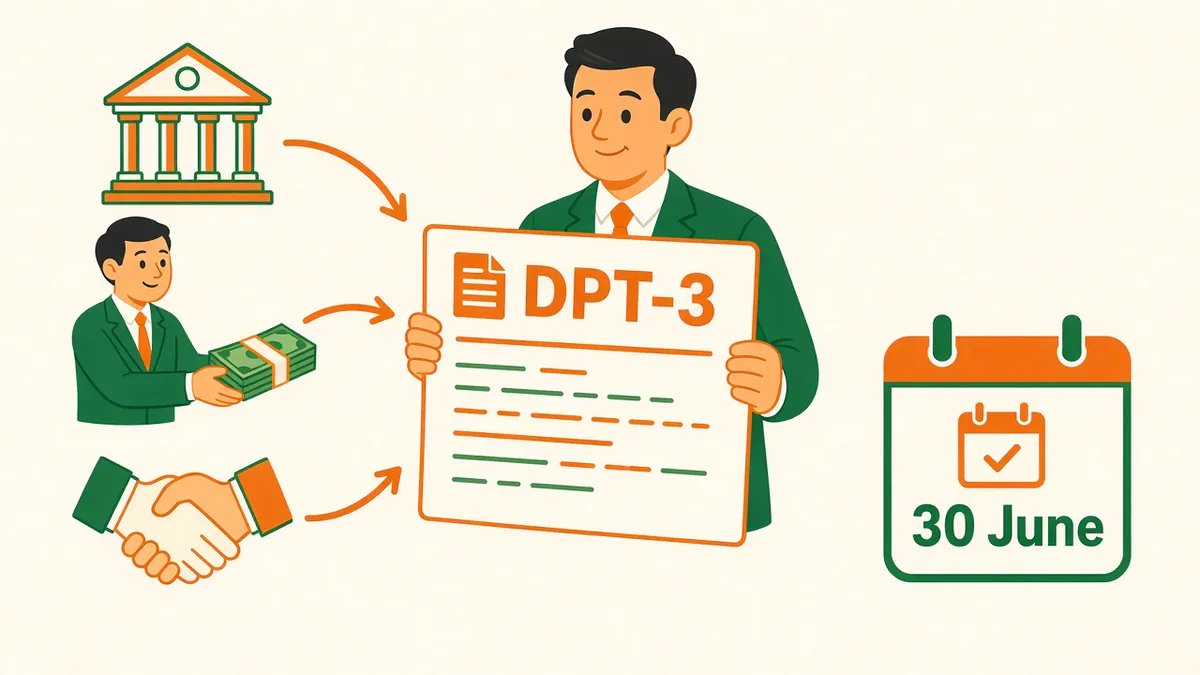
For GST, TDS, employee contributions, DPT-3 and MSME supplier reporting, first establish applicability. Include a return only when the relevant registration, transaction, balance or reporting condition requires it. Tax Year 2026–27 uses the new income-tax framework; avoid mixing its form numbers with saved earlier periods.
Close the year with proof
Assign one owner to each obligation and record the reviewer, due date, submission reference, payment status and final acceptance. Keep a separate event log for director changes, office changes, allotments and resolutions: those filings have their own triggers and deadlines.
One late form does not by itself trigger the three-continuous-financial-year non-filing condition in section 164(2). Equally, paying an additional filing fee does not necessarily resolve every underlying contravention. Review the missed obligation and its consequences separately.
Sources and further help
- Companies Act, 2013: sections 92, 96, 137, 139, 164 and 173 ↗.
- MCA General Circular 05/2026: reproduced circular and original-source reference ↗.
- MCA's KYC announcement, published by PIB ↗.
- Income Tax Department: current announcements Official ↗.
Ask TaxQue to review your compliance file with the year, company category and filing history. This checklist provides general information; the company's facts determine the actual obligations.