A Nidhi's compliance file needs to show more than incorporation and annual ROC returns. It must establish the applicable declaration route, member and financial conditions, deposit controls and continuing reporting.
The first question is when the company was incorporated and under which rule it obtained, or must obtain, Nidhi declaration. The 2022 amendments distinguish newer companies from earlier cohorts. Applying one timetable to every Nidhi can produce the wrong answer. Reviewed on 22 November 2026.
Confirm declaration before treating the business as ready
For companies covered by the post-2022 route, Rule 3B requires the NDH-4 application within 120 days of incorporation, with at least 200 members and ₹20 lakh Net Owned Funds, together with the required fit-and-proper declarations. Incorporation alone does not complete that process.
MCA's public explanation describes the newer route and the government's decision period. If relying on approval, retain the actual filing, receipt, correspondence and approval evidence. Do not treat the passage of time as a substitute for examining whether the statutory conditions were met.
Official MCA announcement through PIB ↗.
Net Owned Funds and paid-up share capital are not interchangeable figures. Prepare the prescribed NOF working from the relevant accounts and adjustments rather than copying the capital amount from the incorporation certificate.
Select forms by their actual purpose
| Form or record | What to check |
|---|---|
| NDH-4 | Applicable declaration/status route, incorporation cohort, conditions and approval record. |
| NDH-1 | Return of statutory compliances under Rule 5(2), where that rule applies; not a universal annual return for every Nidhi. |
| NDH-2 | The particular permission, extension or intimation covered by the current form and applicable rule. It is not an automatic extension of every missed requirement. |
| NDH-3 | Half-yearly return under Rule 21, ordinarily within 30 days after the half-year closes, with the required professional certification. |
| Auditor's certificate | Annual compliance certificate required under Rule 22, kept with the audit reporting. |
| AOC-4 and MGT-7 | Applicable financial-statement and annual-return filings, assessed separately from NDH reporting. |
Rule 5's applicability changes for companies incorporated on or after the 2022 amendment. For an older company, establish the relevant first-year or second-year compliance period and transitional position before deciding whether NDH-1 or an extension application is required. Do not list it as a routine June filing for every year without that analysis.
ICMAI's professional-avenues reference identifies the separate NDH reporting rules ↗. Use the current MCA forms and rules for the actual submission.
Monitor deposits and member records throughout the year
Maintain a reconciled register of members, deposits, loans, interest and the related receipts and payments. Check eligibility and the permitted nature of each transaction before accepting a deposit or granting a loan.
Review the prescribed NOF/deposit ratio, unencumbered-deposit requirements, lending conditions, interest limits, branch permissions and other restrictions against the applicable rules. A year-end form cannot repair an underlying transaction merely by reporting it.
Use a monthly exception report: missing membership evidence, overdue receipts, unreconciled balances, maturing deposits and transactions requiring approval. Give each exception an owner and retain the resolution.
Keep company-law and tax work distinct
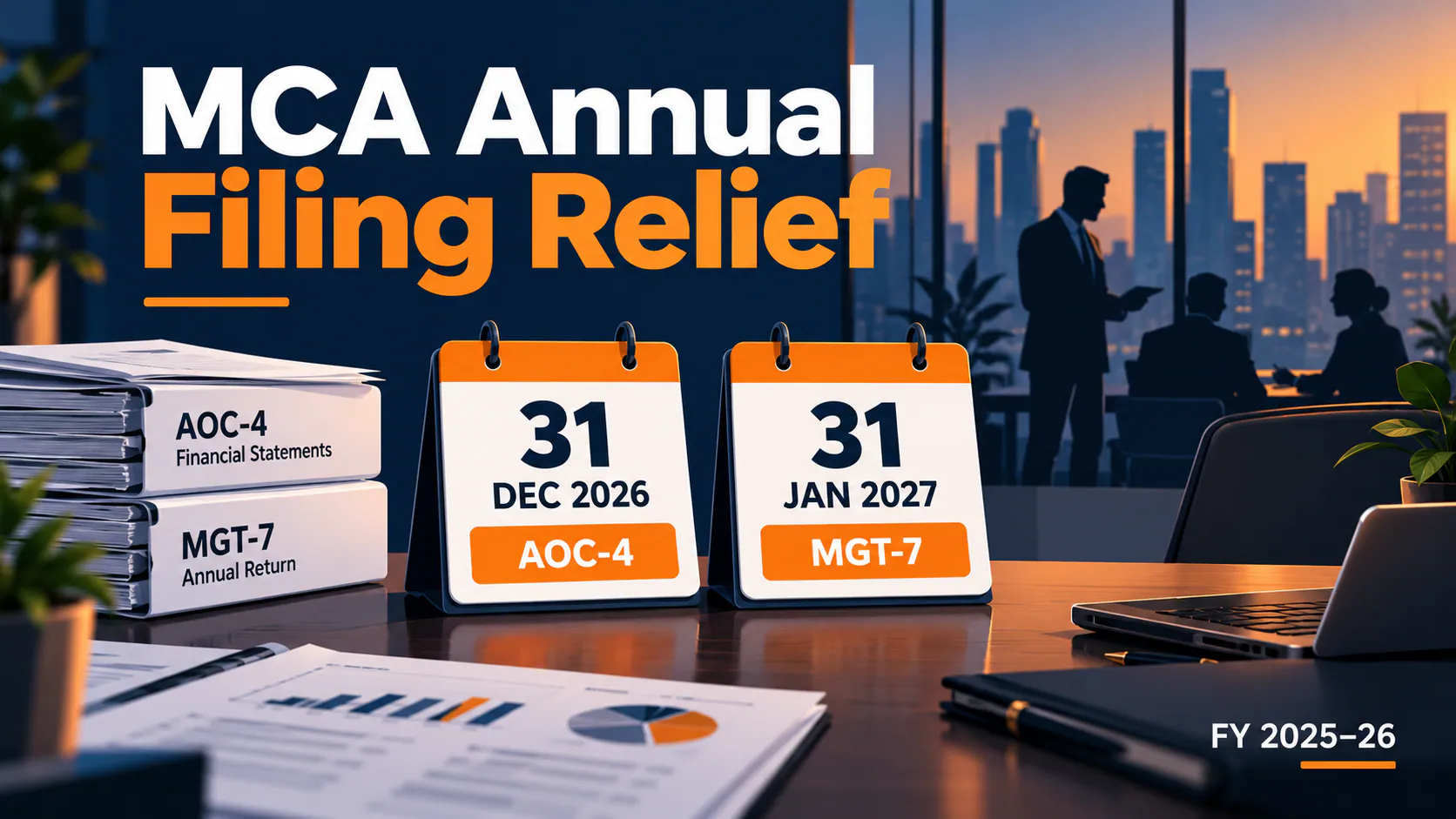
Arrange the statutory audit, Board and general-meeting records, annual financial statements and annual return under the Companies Act. For covered FY 2025–26 forms, check MCA General Circular 05/2026: the additional-fee relief runs through 31 December 2026 for specified financial-statement forms and 31 January 2027 for MGT-7/MGT-7A, without extending the AGM period.
Do not describe ITR-7 as the standard Nidhi return. A Nidhi company ordinarily falls in the company-return framework, generally ITR-6 unless a specific ITR-7 category applies. Select the year, governing law, form and deadline from the actual facts. FY 2025–26 / AY 2026–27 remains under the saved 1961 Act; Tax Year 2026–27 uses the new framework.
GST also requires a supply-based assessment. Do not assume all financial receipts have the same treatment, or that GST annual return is compulsory for every GST registration regardless of the year's exemptions.
If a requirement has been missed
List the missing form, underlying condition, period and correspondence. Establish any restriction on accepting deposits or lending before continuing business. Obtain advice on the available filing, permission or remedial process; do not promise that a fixed fine or a fresh NDH-4 automatically regularises every default.
Keep member communications accurate. Incorporation, MCA declaration and other regulatory records should not be marketed as a guarantee of deposit safety or repayment.
References
- MCA: 2022 Nidhi framework explained by PIB ↗.
- Nidhi Amendment Rules 2022: reproduced notification text ↗.
- MCA portal: current rules, forms and filings Official ↗.
- Income Tax Department: company and other return forms Official ↗.
Contact TaxQue with the incorporation date, NDH-4 history and latest accounts for a scoped compliance review.