Customer Support
TaxQue
Contact Us
Income Tax Services

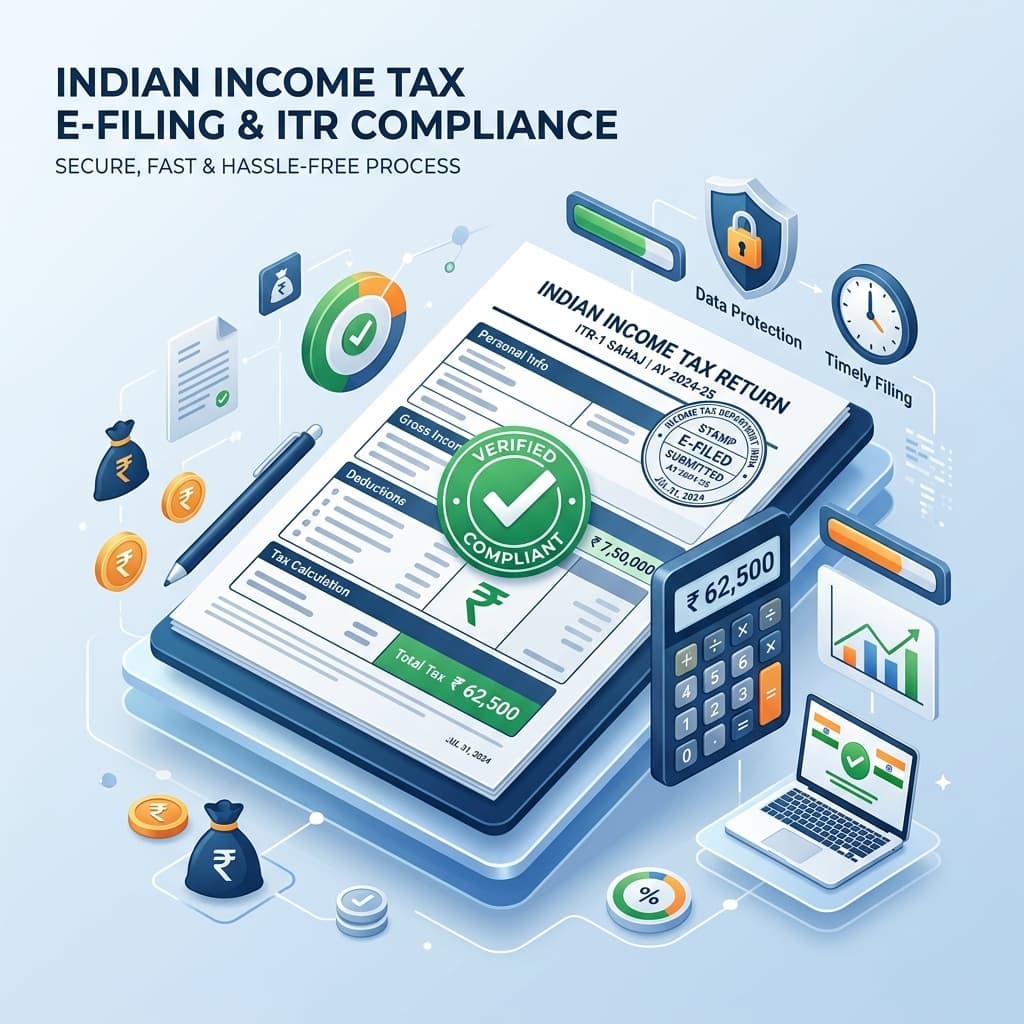
Income Tax E-Filing

Estimated timeline *3–5 Working Days for Filing

Estimated delivery

Timeline conditions

Your individual income-tax filing Allow 2–3 working days for Basic, 3–5 for Standard and 5–8 for Premium once complete income records and approvals are ready. This is exclusively for one individual, one assessment year and one return. We select the legally appropriate form from your actual income and reporting obligations. Basic covers the stated straightforward single-employer salary/pension up to ₹12 lakh, permitted property and ordinary interest. Standard adds the listed multiple salary, directorship and domestic investment work with up to thirty capital-gain entries. Premium covers the stated business/profession or F&O complexity and up to 100 entries, using complete records you provide. Extra transactions or specialist foreign/crypto issues need assessment. No plan includes preparing, correcting or certifying Trading/P&L/Balance Sheets, bookkeeping, audit, audit-report filing or UDIN. For business returns, please provide completed financial statements and schedules; required audits must be arranged separately before finalisation. The agreed filing includes review, computation, eligible tax-credit/deduction checks, return submission, acknowledgement and verification guidance. Notices, later revised/updated returns, extra years and work outside scope are separate. Tax, interest, late fees, approved third-party costs and applicable tax on our fee are extra. Your approval and timely verification are required; refunds, savings and departmental processing dates are not guaranteed. Before we begin The estimate starts after payment, complete readable records, required access and your approval. Working days are Monday to Friday, excluding public holidays. Missing information, pending OTP/DSC verification, your response or portal downtime may pause the work. We will let you know if delivery needs to be revised. Please tell us about any legal deadline before ordering. Booking does not extend that deadline; urgent work needs our written acceptance. Your selected plan sets the work, limits and fee inclusions. Extra work or charges will be agreed with you first. Your statutory rights and our responsibility for the work we undertake remain unaffected.

Prepare and e-file individual and business tax returns: End-to-end tax assessment, deduction optimization, and return filing across all ITR forms (ITR-1 through ITR-7).

Review income, deductions, tax credits and supporting records: Compare tax liability under Section 115BAC to ensure the lowest legal tax payout for your income profile.

AY 2026–27 follows the 1961 Act; Tax Year 2026–27 follows the 2025 Act: Automated Form 26AS, AIS/TIS data matching to ensure swift CPC processing and fast refund deposits.

100%Online Process
24hrExpert Callback
₹0Consultation Fee
Expert Available Now

Get Free Expert Consultation

No commitment · Callback within 24 hrs

+91

By submitting, you agree to be contacted by TaxQue's expert team.
Your data is safe and never shared.

Pricing

Compare plans for Income Tax E-Filing

3 plans available

Basic

₹1,999 /Annually
₹3,49943% off

Individual income tax filing for straightforward salary or pension up to ₹12 lakh from one employer, eligible house property income, savings/FD interest and basic deductions.

WHAT'S INCLUDED

1 benefits
  • ✓Salary or pension income from one employer (up to ₹12 lakh)
⭐Most Popular

Standard

₹3,499 /Annually
₹5,99942% off

Individual ITR filing for multiple salary sources, house property income, domestic investments, company directors and up to 30 listed share or mutual-fund capital gain entries.

WHAT'S INCLUDED

2 benefits
  • ✓Salary and pension income from one or multiple employers (up to ₹50 lakh)
  • ✓Salary or pension income from one employer (up to ₹12 lakh)

Premium

₹5,999 /Annually
₹9,99940% off

Advanced individual ITR filing for complex income, business or profession, F&O trading and up to 100 capital gain entries. Completed financial records must be provided by the client.

WHAT'S INCLUDED

3 benefits
  • ✓Salary and pension income from multiple employers
  • ✓Salary or pension income from one employer (up to ₹12 lakh)
  • ✓Salary and pension income from one or multiple employers (up to ₹50 lakh)

Income Tax E-Filing: AY 2026-27 and New Act Transition

Start by reviewing your income sources and filing history. We help identify the correct return and an appropriate service plan. Individual filing plans exclude company or institutional work unless a separate scope is agreed.

TaxQue helps identify the filing purpose, return or statutory form, required records and current portal steps, then prepares a reviewable draft for authorised submission. Tax payments, verification and any response must follow the form and portal guidance for the applicable year.

What is Income Tax E-Filing?

Income tax e-filing is the online submission of an income-tax return, statutory form, payment, correction or response through the Income Tax Department portal. The correct process depends on the tax period and filing purpose. AY 2026-27 covers FY 2025-26 under the Income-tax Act, 1961; Tax Year 2026-27 covers income from 1 April 2026 under the Income Tax Act, 2025.

Income Tax E-Filing — Income Tax Return E-Filing & Assessment in India — TaxQue

Two tax-law frameworks: The portal continues to support returns and proceedings for earlier years under the 1961 Act while enabling Tax Year 2026-27 compliance under the 2025 Act. Select the correct AY or Tax Year.

Deadlines vary by obligation: Return, audit report, statutory form, tax payment and notice-response deadlines are separate. For AY 2026-27, Circular 07/2026 extended the due date for the specified audited category; confirm exact applicability.

Verify and retain filing evidence: Complete required e-verification and preserve the acknowledgement, payment receipt and portal status. An unverified return or missed notice deadline can have separate consequences under law.

Use current official instructions

Forms, validations, payment codes and dates differ by tax year, filing category and purpose. Check official notifications and notices before submission. The Department processes returns and determines refunds, adjustments, demands and notices.

Process

How to Get Started

1

Step 01

1. Identify the year and filing obligation

Confirm whether the task relates to AY 2026-27 under the 1961 Act or Tax Year 2026-27 under the 2025 Act, and identify the required return, form or response.

  1. 1Verify PAN/TAN, tax residency, filing purpose, assessment/tax year and applicable return category.
  2. 2Check whether a return, statutory form, challan payment, verification or notice response is required.
2

Step 02

2. Prepare and validate the filing

Reconcile supporting records and use the current portal form, schema and validation rules for that year.

  1. 1Check income, deductions, tax credits, payments and linked forms.
  2. 2Resolve mismatches in AIS/TIS, Form 26AS, TDS statements or portal profile before submission.
3

Step 03

3. Submit, verify and track

Submit after client review and authorised approval, then complete the prescribed e-verification or form verification.

  1. 1Save acknowledgement and payment evidence; track processing, refunds, demands or notices.
  2. 2For notices, follow the exact response route and deadline shown in the portal communication.
Documentation

Documents Required for Income Tax E-Filing

The document list depends on whether the filing is an ITR, tax payment, statutory form or notice response. Use the portal checklist for the selected assessment or tax year.

Swipe horizontally to view table👉
Information groupExamplesPreparation note
Identity and portal accessPAN/TAN, e-filing profile, registered contact details, bank account and authorised e-verification method.Check name, PAN and bank details against the portal; never share OTPs or passwords.
Income and deduction recordsSalary, business, property, investment, foreign income, deduction and tax-payment statements as relevant.Reconcile AIS/TIS, Form 26AS and supporting books or certificates.
Linked forms and reportsAudit reports, TDS/TCS statements, Forms 10B/10BB, 15CA/15CB or other statutory forms as applicable.Confirm that each related form is filed in the correct year and before its separate deadline.
Tax payments and creditsAdvance-tax and self-assessment challans, withholding statements and refund bank details.Use the correct assessment/tax year and payment code on challans.
Notice or defect responseOfficial notice, DIN, prior return, supporting schedules and relevant correspondence.Follow the exact response route, document request and deadline in the portal.
Due Date

Income Tax E-Filing Dates: Assessment Year vs Tax Year

There is no single deadline for all e-filing. AY 2026-27 returns cover FY 2025-26 under the 1961 Act; Tax Year 2026-27 covers income from 1 April 2026 under the 2025 Act. Due dates vary by return category, audit status, form and notice.

Swipe horizontally to view table👉
MilestoneWhat determines itImportant note
Return filing deadlineUse section 139(1) date for the specific filer and year; AY 2026-27 includes category-specific extensions under Circular 07/2026.Confirm the exact taxpayer category; not every form or company gets the same extension.
Audit report and linked formsAudit and statutory-form dates are separate from ITR dates; the specified AY 2026-27 audit category has a 21 October 2026 audit date.Verify each form and report deadline independently.
Belated/revised returnAY 2026-27 belated return generally by 31 December 2026; revised return generally by 31 March 2027 or assessment completion, whichever is earlier.Applicable fees, interest and eligibility may differ; check current statute and portal.
E-verificationComplete verification within the time and method prescribed for the filed return.An unverified return may be invalid; keep acknowledgement and verification proof.
Tax payments and installmentsAdvance-tax installments, self-assessment tax and withholding reconciliations follow their own schedules.Use the correct tax year/assessment year and payment type.
New Act transitionReturns for pre-1 April 2026 income continue under the old Act; Tax Year 2026-27 filings use the 2025 Act framework.Select the correct year and current form on the official portal.
Threshold

Income Tax Filing Obligations Depend on Your Filing Purpose

Income tax e-filing has no single income or turnover threshold. Filing may be mandatory based on income, specified transactions, entity category, statutory notice, audit requirement or a form-based obligation. Thresholds and return types vary by year and taxpayer.

Benefits

Why Choose Income Tax E-Filing

A structured process can help taxpayers identify the right year and form, reconcile data, track linked filings and preserve submission evidence.

✅

Correct year and form first

Distinguish AY 2026-27 filings under the 1961 Act from Tax Year 2026-27 obligations under the 2025 Act.

Linked forms and tax data reconciled

Check tax credits, payments, audit reports and statutory forms against the return.

🛡️

Submission and follow-up trail

Keep authorisation, acknowledgement, verification and portal communications together.

Eligibility

Who Needs Income Tax E-Filing Support

Individuals, entities or representatives who need to file a return, statutory form, tax payment, correction, verification or response under the law for the applicable year.

1Confirm the filing task, year and authority

  • Identify the assessment year or tax year and applicable Income-tax Act before choosing the portal form.
  • Check whether the obligation arises from income, entity status, audit, transaction, prior filing or an official notice.
  • Ensure the authorised filer has appropriate portal access and complete records; a filing requirement can exist even when tax payable is nil.

Choose the Correct Income Tax E-Filing Route

E-filing may mean filing a return, statutory form, tax payment or response. The applicable year determines the Act, form and workflow.

Swipe horizontally to view table👉
Service elementTaxQue processWhat the client can verify
AY 2026-27Return for FY 2025-26 under the Income-tax Act, 1961.Use the notified AY form and instructions on the portal.
Tax Year 2026-27Income from 1 April 2026 onward under the Income Tax Act, 2025.Use the tax-year framework and forms notified for the new Act.
Other e-filing tasksStatutory forms, challans, corrections, e-verification and notice responses have their own portal routes.Check exact form, payment type and deadline for each obligation.
Notice responseFollow the official notice and e-proceedings workflow for the relevant year.Notice deadlines and requested documents control the response.
Features

Income Tax Return and Statutory E-Filing Support

Support for the filing route and records needed for the applicable assessment/tax year and portal transaction.

Law and year matched

Confirm whether the obligation uses the 1961 Act AY system or 2025 Act Tax Year system.

📄

Form and data validation

Use current portal forms, schema checks and reconciled income or payment information.

✅

Submission evidence and tracking

Retain filing, payment and verification acknowledgements and monitor official processing.

FAQ

Frequently Asked Questions

Quick answers about Income Tax E-Filing

Our automated income assessment and CA review analyze your sources of income—including salary, house property, business profits, stock/crypto capital gains, and foreign assets—to match you with the exact statutory ITR form (ITR-1 through ITR-7). This prevents Section 139(9) defective return notices.

Generic DIY portals rely on automated algorithms that often miss eligible deductions (80D, 80G, HRA, home loan interest), miscalculate F&O turnovers, and fail to reconcile AIS/TIS data. At TaxQue, every single return is reviewed and authorized by a practicing Chartered Accountant to maximize refunds and ensure 100% audit protection.

For salaried and other non-business individuals, the deadline is 31st July. For business/professional income without audit (including presumptive cases), it is 31st August. For companies and tax-audit cases it is 31st October (extended to 21st November 2026 for AY 2026-27, with the audit report due 21st October 2026). Belated returns can be filed until 31st December.

Filing after 31st July attracts a late fee of up to ₹5,000 under Section 234F (₹1,000 for income below ₹5 Lakhs), 1% monthly interest on unpaid taxes under Section 234A, and loss of the right to carry forward most losses, such as business and capital losses (house-property loss and unabsorbed depreciation can still be carried forward).

Your return is assigned to a dedicated Tax Filing Specialist and reviewed by an experienced Chartered Accountant. You can chat with your CA directly to resolve complex income queries or discuss tax optimization strategies.

CLIENT REVIEWS

What Our Clients Say

Real experiences from 500+ businesses and individuals who trust TaxQue across India.

RA

Ramesh Agarwal

1y ago

Google
5.0

Excellent GST Service

TaxQue handled our entire GST compliance smoothly. The team was responsive and very professional. Absolutely recommend to any business owner!

GST Filing
Income Tax E-Filing
From₹1,999
Newsletter

Stay Updated with Tax Insights

Get expert tax tips, GST updates & compliance guides delivered to your inbox.

🔒 No spam. Unsubscribe anytime.