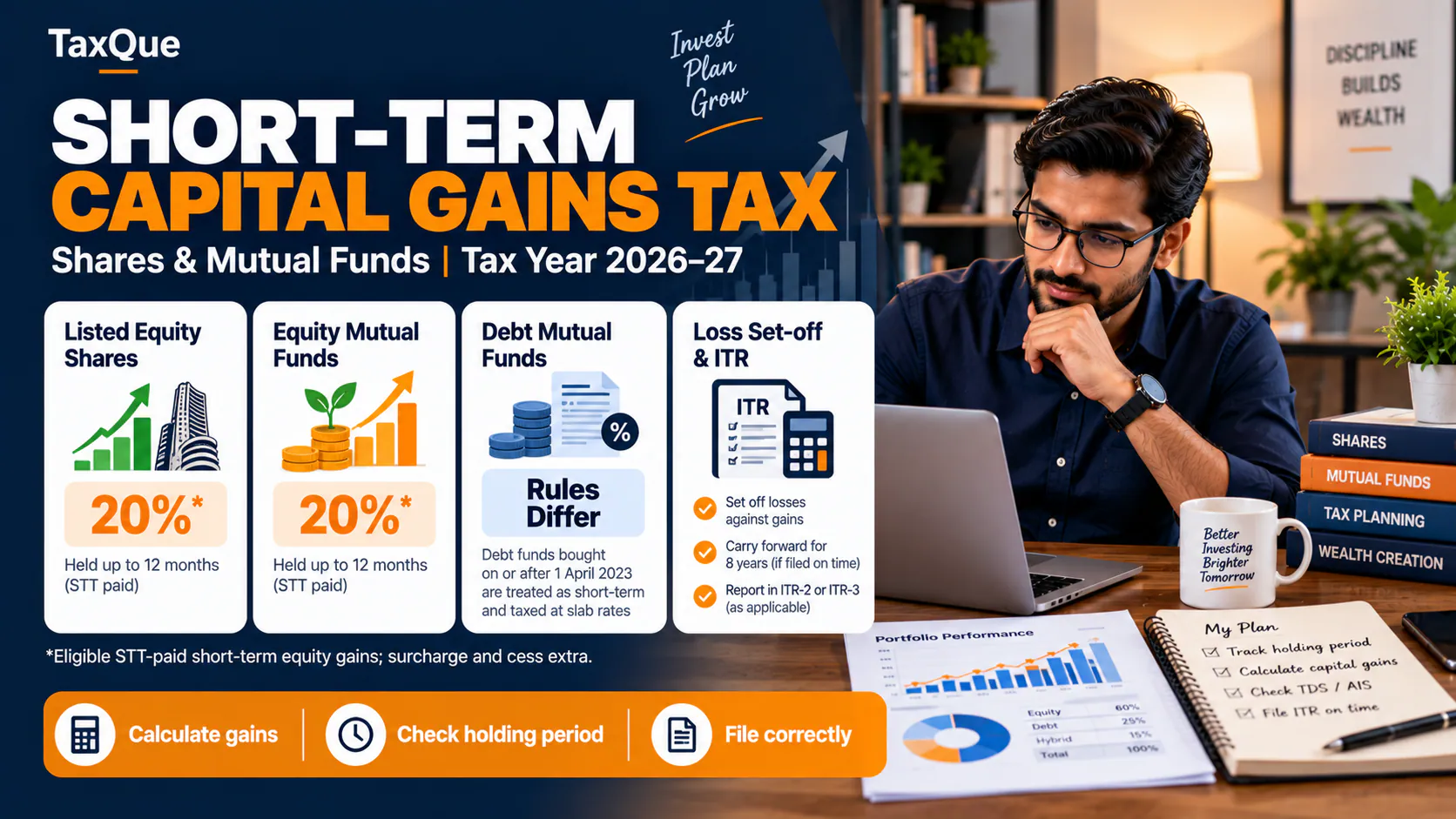
Capital-gains tax depends on the asset, acquisition history, transfer date and taxpayer’s circumstances. The old shortcut—15% for short-term shares, 10% for long-term shares and 20% with indexation for every other long-term asset—is no longer a reliable current calculation.
Start by identifying the income period. FY 2025–26 / AY 2026–27 remains under the saved Income-tax Act, 1961. Income transferred during Tax Year 2026–27 falls under the Income-tax Act, 2025 framework. The Department’s transition guidance Official ↗ explains that distinction. An old section number should not be copied into a current-year working without checking its new-law counterpart.
Classify the asset before applying a rate
For relevant transfers on or after 23 July 2024, qualifying listed securities and equity-oriented fund units generally use a 12-month holding-period test; land/buildings and physical gold generally use 24 months. Long-term treatment requires holding beyond the applicable period.
These are starting points, not rules for every investment. Certain assets, including specified mutual funds and some debt instruments, can be deemed short-term regardless of the ordinary holding period. An investment’s marketing name is not enough to classify it.
The Department’s capital-gains guidance Official ↗ explains the tests and special cases. For gifts, inheritance, bonus issues or corporate actions, ask how the acquisition cost and holding history should be established.
Main rate changes to keep in mind
For qualifying STT-related transactions transferred on or after 23 July 2024, the short-term equity rate rose to 20%, and the corresponding long-term rate became 12.5% on gains above the applicable ₹1.25 lakh aggregate threshold. The threshold is not a separate allowance for each broker, fund or sale.
Many other long-term gains use 12.5% without indexation, subject to exceptions and specific provisions. Short-term gains outside a special-rate category generally enter the ordinary computation. Add applicable surcharge and cess when calculating the liability. The CBDT capital-gains FAQs Official ↗ explain the 2024 rate changes; use enacted law for the actual year’s final calculation.
For Tax Year 2026–27, the Income-tax Act, 2025 as amended by Finance Act, 2026 Official ↗ places the relevant special short-term rate in Section 196, general long-term treatment in Section 197 and qualifying equity long-term treatment in Section 198.
Property: check the protected comparison
For a qualifying resident individual or HUF transferring long-term land or a building acquired before 23 July 2024, the law provides a comparison with the earlier indexed-tax treatment. It should not be described as universal indexation for every property owner or a general option to create an indexed capital loss.
Have both computations reviewed where the protection applies. Keep the purchase documents, improvement evidence, transfer expenses and relevant valuation details together. The Department’s capital-gains guidance linked above discusses this protection.
Build a transaction working
| Item | What the file should establish |
|---|---|
| Asset and ownership | What was transferred, by whom and in what share |
| Acquisition history | Date, cost and any earlier owner or corporate action |
| Transfer | Date, consideration and supporting contract or statement |
| Adjustments | Applicable valuation, expenses and special computation |
| Exemption | Eligibility, amount invested, time limits and evidence |
| Tax payments | Advance tax, withholding and remaining liability |
The taxable gain may differ from cash received. A buyer’s tax deduction is a credit to reconcile, not a replacement for calculating the seller’s gain.
Reinvestment relief needs a separate eligibility check
Older-law references such as Sections 54, 54EC and 54F cover different situations and conditions. They are not interchangeable promises that reinvesting any sale proceeds removes the tax. Check the original asset, eligible taxpayer, qualifying new investment, amount, deadlines, ownership restrictions and any deposit requirement. Use the current-law equivalents for a current tax year.
Do this before committing to a new purchase or bond investment. A product advertisement is not evidence that the full gain qualifies for exemption.
Reporting and final checks
Report gains in the appropriate return schedules. Under the older framework, Schedule 112A is a schedule within the return, not a standalone “Form 112A” submitted for every share sale. Return eligibility must also be checked; some limited long-term equity gains can fit a simpler return, while other facts require another form.
Reconcile all brokers and property records, check available losses and exemption conditions, calculate applicable tax payments and retain the final working. Do not assume a general resident rebate removes every special-rate capital-gains liability.